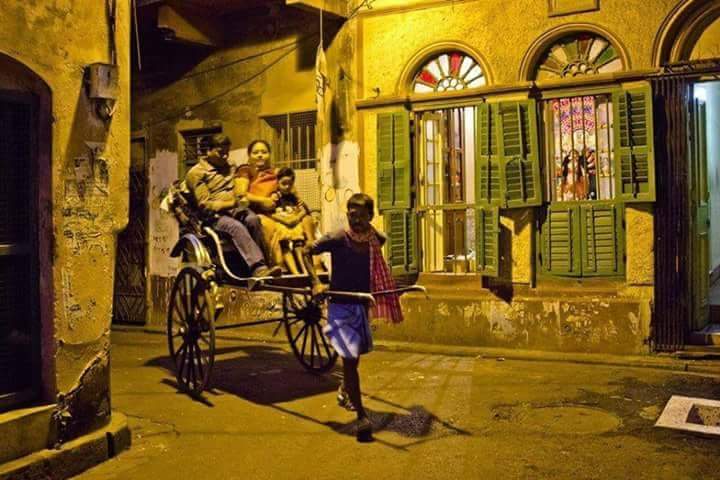
The flavour of Kolkata

The flavour of Kolkata
The city is known for its old alleys. One such is shot by Atanu Pal.
Showing posts with label Photo walk. Show all posts

Friday, February 17, 2017

A tete-a-tete with Soumya Shankar Ghosal

An ardent lover of Kolkata like this blogger, Soumya Shankar Ghosal, a management consultant by profession and a photographer by passion, recently made our city proud when he secured the third position in ‘The 20 Most Influential Street Photographers for 2017’ list from across the world derived from a poll on the street photography website www.streethunters.net. His group Streets of Calcutta is perhaps one of the world’s largest street photography archives dedicated to one city. It was nice to engage with him in a conversation which is as follows. The photos in between are handpicked by the ace lensman from his vast body of work.


1. What does this achievement mean to you? How important is this listing?

Achievement is recognition of your efforts. However, saying so, I must reiterate the fact that achievement is not the ultimate goal. Photography is solely pursued for oneself. The next stage is sharing the joy with others. The third stage is the part of recognition. I am a self-taught photographer and didn’t have the privilege of having a master. Hence, recognition in terms of apperception is an acid test that the photograph has passed exam of sharing the joy with the viewer.

The recent listing is sincerely prestigious one. More so because the list features some of the most gifted photographers I look up to and sharing a little space with them is wonderful. I thank each and every one who felt I should be a part of the top 20 out of the 124 photographers nominated from across the world.


2. Going back to where it began. What got you hooked to street photography and when?

I photographed everything that caught my attention but slowly realized that I had developed an inclination towards Street Photography from around 2008. The street is full of surprises. Exploring the same lane at different times will offer different subjects and perspectives. Exploring streets and knowing the unknown Calcutta is always a fun learning experience.

Oh Calcutta! This is what strikes me each time I explore the city. Although, I was born and have lived in this wonderful metropolis for 36 years, I rediscover the city each time I go out on photowalks. I am never bored walking the same alleys over and over again. Calcutta is a city of diversity. Documenting the diversity helps me learn about the city better.


3. Tell us about Streets of Calcutta. How has the experience been so far?

Streets of Calcutta was born out of a passion to create a shared learning platform for a city-based street photography archive. The objective was to enthuse newcomers who love street photography. What started with a single individual has spread to over 20,000 across social media platforms. We don’t consider SOC as a group. Technically, you don’t need to either join or leave. As long as you love photographing Kolkata, we consider you a part of it.


The forum is quit active in terms of the number of posts on the group as well as Instagram. Apart from the offline interactions have done an online review session which had received more than 225 photos in just 1 hour.


The journey has been pretty exciting! Whatever Streets of Calcutta has achieved is because everyone took an ownership of the subject. Friends Indrajit Lahiri, Nilanjan Pathak and Ayanava Sil deserve a special mention. A special ‘Thank you’ to the brilliant photographers who have encouraged us – Mr. Debarshi Duttagupta, Ms. Lopamudra Talukdar, Mr. Bikas Das and Mr. Asis Sanyal.


4. What do you consider a significant achievement of Streets of Calcutta?

The most significant achievement is Streets of Calcutta has been able to bind together like-minded individuals to educate others about street photography. This genre is not documented much. So when the newcomers, the experienced, the good, the better and the best come together, a vast repository of knowledge is created. We believe in the power of shared learning. I am proud to say, Streets of Calcutta has been able to show street photography in a different light in its 2 years of existence.


5. You do photowalks in the city under Streets of Calcutta. What has been your most memorable photowalk experience?

Every walk is memorable. And yet, there is one walk I particularly remember since it was not about numbers but that of sheer passion for photography of my fellow enthusiasts. That was February 2015 and the walk coincided with an India-Pakistan match. And yet 41 participants turned up.

SOC conducted one of its largest photowalks in August 2015 in association with Amazon India at Shovabazar to celebrate World Photography Day. The participation was recorded at 176. Planning was vital and had to be meticulously executed to manage the big turnout efficiently. Team leads were appointed and briefed in advance and group sizes were kept at a suitable number based in the experience of the team leads. The whole program was managed efficiently with the constant support of the leads and the participants.


6. What are the plans of Streets of Calcutta this year?

We have planned a lot for everyone at SOC in 2017. The execution of the same is being worked upon. Mostly this is related to increasing the offline interactive sessions. Last year we had showcased the work of more than 60 individuals at our exhibition ‘Soul of Kolkata’ in association with ITC Sonar and Nikon. This year too we plan to go ahead with its version 2.0 but with a twist.

To check the Street Hunters list ‘‘The 20 Most Influential Street Photographers for 2017’, click here

If you wish to visit Streets of Calcutta, click here
Instagram handle of Streets of Calcutta: streetsofcalcutta
To know Soumya Shankar Ghosal better, visit his website here. 


#interview #streetphotography #StreetsOfCalcutta


If you liked reading the post, you may visit this blog's Facebook page (click on the link) and hit the 'Like' button to stay connected with the future updates on this blog and more on the page.

Friday, January 15, 2016

The curtain raiser of Apeejay Kolkata Literary Festival 2016, 14th-17th January

January is the season of book fair and literary meets in Kolkata. And AKLF is the first literary meet to roll. Organized by Apeejay Surendra Group and Oxford Bookstore, it had a curtain raiser with a heritage walk on College Street, the city’s book and academic hub, on the last Sunday morning (10th January). The walk was organized by Streets of Calcutta. Rangan Dutta, a well-known travel blogger and writer, led the walk. I joined it at College Square and continued till the end at Swami Vivekananda’s residence. About seventy heads met and took the walk.

The famous swimming club at College Square, named College Square Swimming Club, was founded in 1917 by a group of seventeen people headed by Pramotho Nath Ghosh with the objective of imparting scientific training of swimming and development and promotion art of life-saving in water for the society.

College Square

Calcutta University was the first institution in Asia to be established as a multidisciplinary and secular Western-style university, was established in 1857.

Calcutta University

We were walking along College Street which is the largest book market in the country and also the largest second-hand book market in the world.


The building at the crossing of Bankim Chandra Chatterjee Street where the legendary Indian Coffee House, the heritage coffee shop, is located

The college which was founded as Hindoo College in 1817 was rechristened Presidency College in 1855 and turned into Presidency University by the state government in 2010.

Rangan Datta (in blue) with the participants in Presidency University

There is this plaque near the main gate in the memory of its gate-keeper Ram Eqbal Singh (a harmonious name!) who died chivalrously defending his college in the riots of 1926.


There is this statue, hardly noticed, at the College Street-MG Road junction (diagonally opposite erstwhile College Street market). It is of Rai Kristodas Pal Bahadur who was a renowned journalist (1838-1884) and a legislator. He was awarded the Most Eminent Order of the Indian Empire (CIE). It was an order of chivalry founded by Queen Victoria in 1878.

The statue of Rai Kristodas Pal Bahadur

The old College Street market was demolished to make India’s first book mall by the state government. The showpiece mall named Barnaparichay (The name of the first book in Bengali), perfectly fitting this book-loving city, was conceived in 2007 to be built under PPP. Due to some reasons, the construction is still not complete and only a part of it is operational now. Its main entrance has been kept intact due to the heritage status.

College Street market


The famous  Laha Bari- a house aged more than 200 years, belongs to the Laha family who bought it from another Bengali family. Well known for its Durga Puja and numerous Bengali and Hindi film shoots.

Laha Bari


Thanthania Kalibari, one of the famous temples of goddess Kali, was founded by Shankar Ghosh in 1803, a mentioned in the temple building itself. However, according to another inscription in the temple, its foundation was laid in 1703. The deity is called Siddheshwari and it is made of clay.

Thanthania Kalibari

We stopped by this old sign of a tram stop which has surprisingly withstood eras. An old man in his late seventies sitting in a shop near it was telling us his experience of it seeing our enthusiasm. He said it was already built while he was a small kid. Rangan and Shaikh Sohail, a heritage enthusiast in the group tried to second-guess its age and agreed that it must be more than a hundred years.

 An old tram stop sign from the British era


The Sadharan Brahmo Samaj was formed in a public meeting of Brahmos held in the Town Hall of Calcutta on 15th May 1878. ‘Brahmo Samaj’ means a community of men who worship only Brahma or the Supreme Spirit of the universe.

 Sadharon Brahmo Samaj

The culmination of the walk turned out to be the biggest highlight. We visited the home of Swami Vivekananda which has been turned into a museum by Ramakrishna Mission. The entry ticket costs Rs 10 and you need to leave your shoes in the racks outside. This tranquil place on the busy Bidhan Sarani was Swami Vivekananda's home throughout his childhood and early youth. The large house was built by his great-grandfather Rammohan Dutta. All the furniture and accessories used by him and his family are tastefully preserved and displayed. The anecdotes of his childhood are illustrated through life-size statues.

The condition of the house deteriorated terribly over time. Finally, in 1999, it was acquired along with an adjacent plot by Ramakrishna Mission. It was painstakingly restored through great preparation and research and monstrous efforts with the help of Archeological Society of India over 1999-2004 and made into a museum and cultural centre. It was thrown open for public visit in 2004. There is a short audio-visual played inside which depicts the truly historic restoration. A large auditorium is being built at the backyard now.

The residence of Swami Vivekananda

The adjacent building, now an education centre run by the mission

There was an unofficial sweet ending at Girish Chandra Dey & Nakur Chandra Nandy, the legendary sweet shop at Hedua that specialises in sandesh, not far from the said museum. Indrajit Lahiri and Soumya Shankar Ghosal of Streets of Calcutta treated us with a sandesh each. The naram paak (soft made) nolen gur sandesh handpicked by Indrajit, a food blogger by passion, was sublime to put it in short.


To know more about AKLF, visit its website (Link given in the first line), its Facebook page and Twitter handle.

#AKLF #AKLF2016 #HeritageWalk #CollegeStreet #KolkataHeritage #Kolkata
  
  
If you liked reading the post, you may visit this blog's Facebook page (click on the link) and hit
the 'Like' button to stay connected with the future updates on this blog and more on the page.