The flavour of Kolkata

The flavour of Kolkata
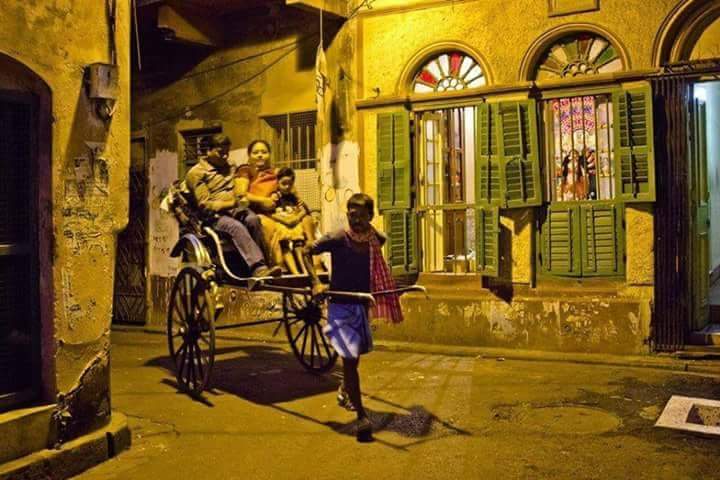
The city is known for its old alleys. One such is shot by Atanu Pal.
Showing posts with label Culture. Show all posts

Saturday, June 09, 2018

Waste Band and the pied piper of Tangra

What is this bunch of youngsters on stage up to with these bizarre things? Thermocol block, empty paint tins and plastic paint drums, cut iron pipes placed in order, half-filled empty PET bottles and stuff! What kind of musical sound will come out of them? One can’t help but wonder when one sees them setting up.

The sound check follows and the thought is hit out of the park. It’s rock sound, man! Welcome to Waste Band.

I came across this band that doesn’t play musical instruments in an annual programme of a new NGO where they performed last, as the main attraction. It plays instruments made out of waste products (as mentioned above) and create musical sound out of them. What I experienced in their session in a cultural show was an absolutely unique innovation in music and a new sound. The band leader plays a guitar (if you call it that) made of a wooden plank and an empty tin!


Their version of digital percussion commonly known as 'Octapad'

Band leader Sanjay Mandal plays his innovative guitar

As for vocals, that’s interesting too. The youngest boy who also plays the iron pipes with a spanner sang some rhymes in rap. They also mix a conventional instrument or two when needed. Like this girl, Payel, played flute accompanied by a few of her bandmates on their respective instruments in one of the compositions. I only wished they got a full session to play as they had to cut it short due to lack of time left to close the function.


The story behind it, as shared by band leader Sanjay Mandal whose brainchild it is, is an amazing and inspiring social initiative. I am proud to know this has happened in Kolkata.

Tangra, by Sanjay’s own admission, is an area is Kolkata which is educationally, culturally and financially backward. Boys drop out of school early and do small jobs to support the family. Sanjay, who seems to be in his forties, is one among them. Despite the compulsion and hardship destiny posed, he wanted to do something different in life with the local youngsters of school-going age engaged in earning. So, he started an after-work recreation session of music with instruments built out of things thrown away (They couldn't afford proper instruments and training). Soon the boys got hooked to it and a band was formed. They got noticed by renowned band Bhoomi in one of their early shows in 2006 and performed in their television show Barandaay Roddur.  

The vocalist is playing his instrument made of iron pipes with a spanner

Their journey has taken them to the popular national television show ‘India’s Got Talent’ and NDTV where they performed live. Today, they do shows in various parts of India and abroad.

A bagful coins is an instrument for them

We wisecrack, “When life gives you lemons, make lemonade”. Sanjay and his gang live up to it, day in and day out.  

The earning from the shows is saved for greater good. Sanjay’s aim is to build a school for the local children. A small piece of land has already been purchased. Sanjay is also getting some of the band members, which now has a few young girls too, trained in formal music.

The Waste Band

Hope Sanjay Mandal, the pied piper of Tangra, goes from strength to strength with his band of boys and girls embracing music with passion.

If anybody is interested to call the band for a show, Sanjay can be reached at 9330832732.


#WasteBand #KolkataMusic #IndiasGotTalent


If you liked reading the post, you may visit this blog's Facebook page (click on the link) and hit the 'Like' button to stay connected with the future updates on this blog and more on the page.

Tuesday, January 10, 2017

Conversations with Srijit Mukherji

“Dhur, ora abar audience naki, audience toh amra….Dekhechho tomaay je tweet-gulo korechhe taate kirawm banan bhool!” (You call them your audience! Have you noticed their tweets? They can’t even spell right in English! Mind you, it’s us who are THE audience you can call your own.)

His core audience is this possessive about his work! And he probably realized it in this fashion only after his last release Zulfiqar (October 2016) – a double adaptation of Shakespeare’s Julius Caeser and Anthony and Cleopatra into an unabashed mainstream movie – his first full-fledged attempt to mainstream cinema by his own admission. 

The above is a glimpse of the candour with which the director spoke in this recent chat show.

Right from the day Sujoy Prosad Chatterjee, a well-known performing artist, conceptualiser and director of refined and innovative cultural productions, posted on his Facebook profile that the last edition of his live talk show ‘Conversations’ in 2016 would feature director Srijit Mukherjee as the guest, requests kept on pouring on his timeline for blocking seats. I know Sujoy for a long time as I’ve organized shows directed, anchored and performed by him, and I was aware of his live talk show for a long time. So, I wasted no time to confirm my presence.

Conversations, as Sujoy says, is the only live talk show in Kolkata.

I walked in at The Palms, the multicuisine restaurant on Southern Avenue, the venue, well in time around mid-December. Someone in a black shirt walked in alone just ahead of me. I noticed that it was Srijit.

The medium-sized banquet kept filling steadily and as Sujoy took the mike just past 7.30, not only the seats were full, but many were standing at the rear.

Conversations started on the most speculated topic about Srijit at this point of time – his Mumbai stint – Has he shifted base to Mumbai for greener pastures? Will he not come back?


Srijit clarified that he has not shifted base at all and has no intention of doing so now. He shared that the first time he went to Mumbai was when he was offered to do a Hindi remake of his niche film Hemlock Society – a black comedy. It did not work out as the actor who would play the protagonist suggested a few changes in the script. Since then it has been a wait for the most successful director of Bangla cinema of the present times to make the first Hindi film on own creative terms. And Rajkahini, which made Mahesh Bhatt ecstatic, gave him the right opportunity. As it is well known, its remake is under production in Hindi as Begum Jaan with Vidya Balan in the titular role under the banner of Mukesh Bhatt and Mahesh Bhatt. Srijit added, the character of Begum Jaan was originally written for Vidya, which explains the abundance of Hindi lines said by the character played by Rituparna Sengupta in Rajkahini.

I was aware that this was not the first time Srijit’s film was being remade in another language. The one before Rajkahini, and the first, was Hemlock Society in Marathi. The director informed that it was named Welcome Zindagi.

The director revealed that he had to shoot Begum Jaan on a shoestring budget compared to Hindi cinema. He, in fact, has always had to work within a tight budget in his seven-year-long directorial career (Rajkahini is known as a prime example) and has learnt to live with it. To be more precise, he added, except for the cost of cast, the Hindi version wasn’t much ahead of the Bangla original in terms of budget. Then the film suffered huge adversities in the making (again, a fate of some of Srijit’s films). The director of photography quit the unit days before the first schedule and the set of the haveli where most of the film happens, erected in Jharkhand, was devastated by strom. To put it in perspective the director quipped, “It was resemblant of what we see of the puja pandal of Mudiali during its making in the month of August”. The shoot for a day had a plan A and a plan B depending on real time condition of the shooting zone. The cast and crew went through immense hardship through the shooting and the director saluted the spirit of Vidya in pulling it off.

Srijit informed that talks are on to remake Hemlock Society and Chotushkone (his immensely successful thriller) in Hindi. He is also researching on Noti Bonodini for a film on this legendary theatre actress from Kolkata.

Around this time, Sujoy, who was steering the conversation deftly, turned to the audience and invited questions. Someone asked Srijit whether he would be casting directors as some of the central characters in the Chotushkone remake, to which Srijit informed that things were different in Mumbai. Here in Bengali cinema, also in Marathi and Malayalam cinema, directors are revered like star actors, while in Mumbai it is a star-driven system. So it won’t generate as much of curiosity as it did when the famous directors Aparna Sen and Gautam Ghosh played the protagonists in Chotushkone. He was quick to add that Sanjay Leela Bhansali was a bright exception.

He talked of his experience of waching Sanjay Leela Bhansali, one of the friends he had made in Mumbai, on the sets. The whole cast and crew is scared of him and his obsession with details is the stuff legend is made of. It can so happen that he spotted one of the many group dancers in the rear of the floor not doing his/ her step right and as a result he will halt the take and do a re-take even if it is the fourteenth one. Srijit named an A-list actress who appears completely different when Sanjay is on the sets. Sanjay even shows dance steps his heroine if he is not satisfied with the take. Many don’t know that Sanjay is good at choreography and he directed the song sequences of 1942 : A Love Story.

Sujoy asked Srijit about the most hotly debated topic about him of the times – what prompted him to make a hardcore mainstream flick like Zulfiqar (released in October 2016). At the outset, Srijit admitted that Zulfiqar was unlike his other films and it didn’t work at a critical acclaim level and it evoked extremely polarized reactions. Many people from his core audience had problems accepting that he had made a mainstream movie. But the director set the record straight saying that he really wanted to have a shot at mainstream cinema.

Elaborating on the audience reactions to Zulfiqar, the director disclosed that there was a sharp divide between his core audience and the new audience he got with the film (like those in small centres like Baruipur and Seoraphuli). In the age of social media, everything is open to public. So the tweets and Facebook posts praising the film were noticed by his core audience members many of who were unhappy that the film was attracting such quality of audience. Srijit quoted a representative remark to show how strongly dismissive a section of his core audience was of this new audience –“Dhur, ora abar audience naki, audience toh amra….Dekhechho tomaay je tweet-gulo korechhe taate kirawm banan bhool!” (You call them your audience! Have you noticed their tweets? They can’t even spell right in English! It’s us who are the audience for you.). The director, however, made it a point to acknowledge in the show that he owned his new audience just as he owned his core audience.

The director urged the audience in the show to let him make his kind of cinema. “Please don’t box me, let me be”, said he.  

Since he now has a body of work built since 2010, Sujoy asked him to pick his favourites. Srijit stated that it was like picking his favourite children, however, if it had to be done, it would be Jaatishwar, Hemlock Society, Baishe Shrabon, Chotushkone and  Rajkahini.

The conversation was at the last lap. Sujoy invited questions from the audience and many pitched in. Noted film critic and journalist Shoma A Chatterjee attended the show and she shared her honest view on Srijit that he could do much better. She added that directors shouldn’t act as protagonist in their own films as that runs the risk of narcissism. Srijit gracefully accepted this and revealed a piece of information for the first time – When he was making Autograph (his debut film), Shoma wrote a wrong email to him with a word of encouragement. She narrated her story of struggle in it. Srijit acknowledged that it was inspirational to him.

Post event, the director was surrounded for photographs, selfies and more questions which seemed endless and showed the stardom he enjoys in his city.

There was some refreshment for the audience post-show from The Palms. I liked the succulent and done-to-perfection chicken kebabs and the fried vegetable wontons.

Finally, one line for the host - It was such a delightful and insightful conversation with a sprinkle of wit and humour (by both the host and the guest) because of the excellent conversationist Sujoy Prosad Chatterjee. I am looking forward to the next season of Conversations. 


#TollyDiaries #livetalkshow #conversation #SrijitMukherjee #Cinema #BengaliCinema

If you liked reading the post, you may visit this blog's Facebook page (click on the link) and hit the 'Like' button to stay connected with the future updates on this blog and more on the page.

Sunday, October 09, 2016

Pujo 2016

Here are some moments from Pujo (as Puja is called by Bengalis) which is going on from
7th (Shasthi) to 11th October 2016 (Dashami).

A pandal (marquee) made of grass in Talbagan, Barrackpore in north suburbs of Kolkata

 A pandal designed like an old, decaying mansion in Nonachandanpukur, Barrackpore

The pandal in Nonachandanpukur, Barrackpore

Human models in the pandal in Nonachandanpukur, Barrackpore

Puja is now being referred to globally as 'World's largest art gallery' thanks to the incredible popularity of theme in creating the pandal (marquee) and the idol of goddess Durga among thousands of pujas organised in Kolkata. Let me also say for the records that Puja, without doubt, is one of world's largest and greatest festivals which draws several lakhs of crowd in the city in just the five days.The themed pandals that mesmerize the visitors are actually huge art installations created by qualified and self-taught artists over a long time. The districts have followed in the footsteps competently and have been drawing crowds as well. The picture of the pandal below from the adjoining district of North 24 Parganas is representative of the fact. Many pandals in suburbs and districts can give those in the city a run for their money.
   
The pandal in the puja of Anandamath, Ichhapur in northern suburbs of Kolkata. 

Loved the classical form of idols of goddess Durga and her two sons and daughters in this puja in Ichhapur. Since as per Hindu mythology Durga killed the monster Mahishasura in a fight, her face is supposed to look feisty and angry. This is aptly expressed in the right degree in this idol.


 No Pujo is complete without khichhudi bhog


#Puja2016 #Bhog #WorldsLargestArtGallery


If you liked reading the post, you may visit this blog's Facebook page (click on the link) and hit the 'Like' button to stay connected with the future updates on this blog and more on the page.


Sunday, May 08, 2016

A unique Bengali new year calendar

I read in Ei Samay, the Bengali daily, a few days ago that a Bengali new year calendar was printed in thirty thousand by a leading cake shop chain, and it went out of stock within two weeks of the Bengali new year day this year (14th April) or less, thanks to the demand from customers among whom it was distributed.

Drooling over a calendar of Bengali new year (it’s 1423), something that most of us don’t follow except for certain times of the year! Also, the creative aspect of such a calendar is generally not worth writing home about. So this one had got to be something extremely special, I thought.

The name of the creative agency (Mayurakshi) and that it was for a leading cake shop chain rang a bell. So when I was in Mio Amore earlier this week and had a fleeting glance of someone walking out with a sophisticated rolled up calendar, I asked a salesman whether they had come up with a new year calendar. As he answered in affirmative, I asked whether it was for a price. He embarrassedly said no, and picked up and handed over one to me. It was a wonderful reward from the chain to me for being a loyal customer for many years.


It is a theme calendar based on Satyajit Ray and the legendary sleuth created by him- Feluda, produced in association with the Ray family and Ray Society, with a well-worded foreword by Sandip Ray. It celebrates the fiftieth year of Feluda’s debut in Bengali literature. Sandip has revealed how Feluda had gradually developed noticeable resemblance in psychological traits and similarities in physical traits and dress sense with his creator.

The calendar presents the versatile creative genius of Ray, from writing, illustration and book designing to various aspects of filmmaking.

It starts with the manuscript of the first Feluda story- Feludar Goendagiri along with its published illustration and the book cover design of Joy Baba Felunath.

The manuscript of Feludar Goendagiri

It then walks into his world of filmmaking where we see the first page of the Sonar Kella script, Ray’s work on the production design (like the sketch of Feluda’s room in Sonar Kella), costume design and character sketches.

The first page of Sonar Kella script (Middle at the left)

The sketch of Feluda’s room in Sonar Kella

The character sketch of the knife thrower Arjun (Right) and the design of the dart board in Joy Baba Felunath

Costume design for Sonar Kella

There are stills of the making of the two Feluda films made by Ray showing him busy in the shooting with the actors.

The maestro earnestly believed in getting every small detail right in his films and used to be personally involved in ensuring the same. The shooting stills of Joy Baba Felunath in the calendar bear ample testimony to it. How many of us know that the freeze-frame at the end of Joy Baba Felunath showing the title written on stone at the Beneras ghat was created by Ray himself?

Ray adding touches to the Durga idol in Joy Baba Felunath 

The master writing the title on stone in Benaras which we see in the 
freeze-frame at the end of Joy Baba Felunath 

My sincere thanks to Mio Amore for creating this collector’s item where they have cheered for the Bengali intelligence and creativity.


#BengaliNewYear #SatyajitRay #Feluda50 #FeludaFilms #MioAmore


If you liked reading the post, you may visit this blog's Facebook page (click on the link) and hit the 'Like' button to stay connected with the future updates on this blog and more on the page.

Friday, March 04, 2016

Celebrating Bhasha Dibas (International Mother Language Day)

There was this ensemble show celebrating Bhasha Dibas (otherwise known as International Mother language Day) on 21st February organized by Patra Bharati (publishing house), Kabita Club and Shabdabaji at Oxford Bookstore. The speakers were singer Riddhi Bandopadhyay, singer-composer Surojit (of the band ‘Bhoomi’), famous science fiction writer Anish Deb and publisher Tridib Chattopadhyay (of Patra Bharati). Writer Ranjan Bandopadhyay joined later. The show was compered by RJ Roy who runs Shabdabaji, a Bengali word game-based initiative which has become popular over the years.

The speakers presented their takes on how Bengali as a language is relevant and how it is evolving in today’s times.

(L to R) Riddhi Bandopadhyay, Surojit, Anish Deb and Tridib Chattopadhyay 
 RJ Roy

Tridib had an interesting view. How can the children and youngsters who haven’t lived in Bengal or don’t have/ haven’t had Bengali as one of the languages in the school read Bengali literature if they wish to?  The question is because they can’t read Bengali. Can’t publishers think of experimenting in Bengali in English font? The language has to move and be relevant across generations and this idea addresses that. There are some Indian languages that he named which don’t get published in their own alphabet but it hasn’t affected speaking in those languages. If such experiments are not done the young generation studying in English medium will not read in Bengali.


He has published the work of eminent Bengali writers like Bankim Chandra Chattopadhyay and Radhanath Gupta in today’s language. He even came up with comic strips based on such work. There was a lot of criticism from purists. But the work found a new language and reached a new audience at the end of the day.

The use of Bengali by today’s generation was discussed, including the new-found use of words like byapok, chaap and ayakghhawr. The panel supported the use and I completely second the view because a. The words are apt expressions and b. It prevents the use of English or Hindi words for the same expressions.


Ranjan Bandopadhyay was the most distinguished among the speakers not only for his stature but also for the fact that he has studied in Bengali medium but he has been teaching English literature for a long time and has profound command in Sanskrit as well. His teaching style includes quoting lines from Bengali literature so that his Bengali students can relate better.

Ranjan Bandopadhyay (Sitting, first from left)


Members of Kabita Club recited their own poems. The head of Kabita Club (In the first picture below) enthusiastically shared that thanks to social media many poems by young aspiring poets are being seen on Facebook and getting their due appreciation. The Facebook page of Kabita Club is extremely popular, as she stated.


#BhashaDibas #Bengali


If you liked reading the post, you may visit this blog's Facebook page (click on the link) and hit the 'Like' button to stay connected with the future updates on this blog and more on the page.


Sunday, February 14, 2016

The cross-country cycling trip celebrating International Mother Language Day

The day 21st February is significant for Bengalis all over the world, especially those in Bangladesh. It is known as International Mother Language Day for observance all over the world to promote awareness of linguistic and cultural diversity and multilingualism. The observance of the day marks a decades-long movement (known as Bhasha Andolon or the movement for language) for the recognition of Bangla (Bengali) as one of the two national languages of East Pakistan (which later became the country of Bangladesh), in which students were shot dead in Dhaka on 21st February 1952. The day was acknowledged as a day of significant importance and to be known as International Mother Language Day (better known to Bengalis as Bhasha Dibas) by the United Nations in 1999 and it is being observed worldwide since 2000. 

A group of six adventure sports lovers under the banner of Touch of Heaven (an adventure sports organization) is celebrating it this year in a special way. They are embarking on a cycling trip from Kolkata to Dhaka from today. They are going to take part in the grand Bhasha Dibas programme on 21st February in Dhaka. The trip has been named Aksharjatra.

The trip through suburban and rural Kolkata and Bangladesh will also seek to understand the grassroot culture that was the root behind the revolution. It should also contribute in its own way to the bonding of Bengalis from India and Bangladesh. It is being led by the Chandan Biswas, 30, a photographer and adventure cyclist. Others in the group are Ankur Barman (24), Rahul Sen (26), Rajat Saha (46), Subrata Chatterjee (42) and Ransdale Manuel (40).

 The group with the cycles

Chandan Biswas, the group leader

The group with the Indian flag at the press conference
The itinerary reads as:

Day 0- 12th February- Flag-off at Press Club, Kolkata
Day 1- 14th February- Journey starts from Eden Gardens and reaches Bangaon, India (80 km).
Day 2- 15th February- Bangaon to Jessore, Bangladesh (40 km)
Day 3- 16th February- Jessore to Magura (58 km)
Day 4- 17th February- Magura to Faridpur (52 km)
Day 5- 18th February- Faridpur to Manikganj (68 km)
Day 6- 19th February- Manikganj to Dhaka (58 km)
Day 7- 20th February- Rest and local amusement
Day 8- 21st February- Bhasha Dibas programme at Dhaka. Boarding a bus to Benapole at night.
Day 9- 22nd February- Back to Kolkata by cycling/ train

For updates during the trip (as available from Chandan) visit the Facebook page of this blog (find the link at the end of this post or click on the widget of the page on the sidebar). Updates will also be available on my Tweeter handle anirban48.

Wishing the team all the very best and a safe and fulfilling journey.


#Ridefor21 #Aksharjatra #TouchOfHeaven


If you liked reading the post, you may visit this blog's Facebook page (click on the link) and hit the 'Like' button to stay connected with the future updates on this blog and more on the page.

Monday, January 25, 2016

An afternoon with Christine Manfield in AKLF

It was the closing day of the well-organised Apeejay Kolkata Literary Festival (AKLF) which took place at various venues including Oxford Bookstore, Victoria Memorial, Town Hall steps and Tolly Club, covering a wide range of subjects in standalone or book release-linked discussions over 14th to 17th January.

The first session of the event was the release of the new book ‘A Personal Guide to India and Bhutan’ written by Australian Masterchef, food and travel writer Christine Manfield, by veteran journalist Vir Sanghvi, followed by a conversation between the Masterchef,  him, musician and food writer Nondon Bagchi and chef Sharad Dewan of The Park, which was the venue. It was succeeded by showcasing Christine’s book ‘Dessert Divas’ with Meera Syal and a demo of one of the desserts from the book.

Before proceeding further, a few facts about Christine Manfield:
  1. She is deep into food tourism and has been conducting food trips to India for years. She has been travelling to the country by its length and breadth for the last 20 years. Her coffee table book ‘Tasting India’, which is said to be a delectable cross between a coffee table book and a travelogue, is an outcome of this.
  2. Use of spices is her forte. Her favourite spices include chilli (first in order), turmeric, saffron and mustard seed. No wonder she is known as Mistress of Spices.
  3. She can’t live without rice and chilli. So much so that she carries chilli to places that don’t grow them.
  4. When she’s at home, she shops daily and doesn’t like stocking up for days. Sounds like a quintessential Bengali habit? There’s more to relate for Bengalis. Her Bengali favourites include luchi, shukto (she finds it really light and cleansing) and kochuri on the streets.
  5. Though she’s been a guest chef on the Masterchef Australia, she doesn’t think such ‘game shows’ are the right platform to learn to be a good cook or chef.

Reference: Her interview in t2 by Samhita Chakraborty in 2011.

Back to AKLF. I regret turning up late at the well-attended first session. But the short while I witnessed, was thoroughly enjoyable. Christine is good to listen to. She is well-spoken and articulate and has a good sense of humour. Because of her long experience of India, she knows Indian food by heart.

(Left to right) Christine Manfield, Nondon Bagchi, Vir Sanghvi and Sharad Dewan

The Q&A session that followed was interesting too. An old gentleman asked why a nation’s cuisine changes when it crosses the nation’s borders. The reference was to Chinese food which as he had experienced and heard, was bland in China and very unlike what is available by its name in India, even if Chinese cooks make it. Vir said he didn’t agree to the blandness thing completely because food in China has a wide variation in taste. While food in Peiking is bland, Hunan or Szechwan food are spicy. Nevertheless, the question was addressed.

The beginning of the Q&A session

Sharad said the similarity in taste depends a lot on the water. One of the things a dish derives its taste from is water and as that varies with a change in geography. So the taste of food changes too, no matter how authentically it is attempted to prepare.

Christine’s view was that a cuisine in the first place has to appeal to the people having it. So the taste of a cuisine can change in different corners of the world to some extent to adjust to local taste.

Nondon shared an anecdote of his younger days. He was in Chennai on a trip and became broke towards the end of the trip. So they had to survive on cheap local food. He still remembers the sambhar he had there. Back to Kolkata, he has had sambhar at many places cooked by south Indian chefs, but it has never been the same. It is impossible to replicate the original taste far away from an area.

 Interaction with audience

In this context, here is a word on the ‘Kolkata Chinese cuisine’. The early Chinese cuisine of Kolkata, served in restaurants like Nanking in the 20s’ was subtly flavoured, close to what it is in China. But with time, the taste evolved to suit local taste more. Thus green chilli sauce was born, marrying Chinese and Indian flavours, in the hands of a Chinese gentleman living in the city. It was followed by other sauces like chilli garlic and hot garlic which have nothing to do with China but everything to do with Kolkata’s palate.

There was a supposedly short tea break between the sessions. But given the wide array of items served- finger food and dessert, and the large attendance, the queue was slow to move and seemed never to end. There were chicken breast (mini) cutlet (with tartar sauce), small mangsher shingara with tentuler chutney (tamarind chutney), Joynagarer moa, sandesh and mini lemon tart among other things. Not surprisingly, with such a delectable spread the short break was getting longer and the moderator lady had to make repeated calls to the audience to be back on seats.

 Mangsher Shingara (left), chicken breast cutlet (centre down), Joynagarer Moa (Centre up), ), sandesh (right up)
and mini lemon tart (right down)

In the next session, where Christine’s new book ‘Dessert Divas’ was showcased, she was introduced as ‘The queen of decadent desserts’. In Christine’s words, a dessert is ‘seduction through the eyes’. The book is divided into six chapters and four seasonal sections including summer desserts, winter desserts and spring desserts. This session saw a full house.


Over the next half an hour or so, we saw the title pages of the desserts in the book projected on the screen at the right and Christine described one by one. I must mention, the names are imaginatively and wittily given.


(Left to right) Christine, Meera Syal and Sharad Dewan

The Summer Desserts section has desserts like ‘I go to Rio’, a banana-based dessert- ‘Bananarama’, named after a popular rock band, ‘Bite the Pillow’ (The pillow is of marshmallow with lemon tart at the centre). There is one called ‘Sticky Fingers’ made with pomegranate, fig and organic honey. The pomegranate seeds are soaked in the honey and the longer they are in the honey, the better they taste. There was another one called ‘F.I.G. J.A.M.’, which seemed it meant the obvious, but the audience had a good laugh when she expanded the name. It was …..'F**k, I’m good, just ask me'.

“Apples are good in winter”, she said. So the Winter Desserts section had many apple-based preparations. ‘Bithday Suit’ was one of the desserts and the demo that followed was of this. ‘Queen Bee’ and ‘Adam’s Downfall’ were two others.

Spring Desserts had names like Rock the Kasbah, Strawberry Fields Forever, Menage a Trois and Mocha Bomb (A chocolate mousse on the bed of espresso ice cream).

She moved on to the table at the left for the demo of ‘Birthday Suit’. The printed recipe had been circulated to every audience member before the session. She explained every step in great detail and much of her interaction with Meera happened at this stage. It was made of meringue puff, white chocolate mousse, lemon curd (made of egg yolk, castor sugar, lemon juice and cold, unsalted butter), raspberry and raspberry sauce.


Session over, the audience was privileged to taste it. I liked it because of the tangy raspberry sauce.


#AKLF #ChristineManfield #DessertDivas


If you liked reading the post, you may visit this blog's Facebook page (click on the link) and hit
the 'Like' button to stay connected with the future updates on this blog and more on the page.