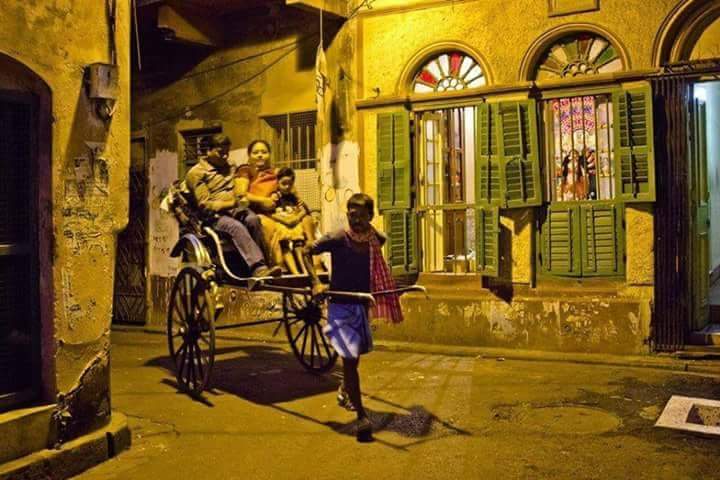
The flavour of Kolkata

The flavour of Kolkata
The city is known for its old alleys. One such is shot by Atanu Pal.
Showing posts with label Books. Show all posts

Tuesday, April 16, 2019

Food Kahini hits the bookstores

"Ritu-da (Rituparno Ghosh) used to call her by the name of a food"

"Shut up!"

Mir was going to spill the beans about the name as food was the theme of the conversation with the guests at the book launch and actor Sudiptaa Chakraborty tried to dissuade him in vain. Well, the pet name that Rituparno gave her in their very first meeting was ‘Gutke kochuri’ (A small version of kochuri or kachauri). Let’s be a bit fair to Sudiptaa and not get into what actually prompted him in giving that name.

It was the evening of the launch of Food Kahini, the food book that turned well-known Kolkata food blogger Indrajit Lahiri into author. And it happened in style. The starry April evening at Peerless Inn had composer-singer-lyricist Anupam Roy, actor Aparajita Auddy and singer Lagnajita Chakraborty apart from Sudiptaa as guests and as the cherry on the cake, Mir was the host. Mir, incidentally, plays the ‘Bhaipo’ (Nephew) in the food-based web series ‘Foodka’ with Indrajit in the titular role of the uncle who is a knowledgeable foodie. It is into its third season (Available on YouTube).

Anupam sharing about his weakness for sweets

Mir had already asked Anupam about his foodie side and shared with us his deep love for sweets. He also asked the famous composer in jest what all he keeps in his fridge since his romantic songs often have names of vegetables (Like dry spring onion). It was followed by Aparajita who confessed her obsession for khichudi (Khichdi). She shared a childhood incident, with an annual occurance, where her parents used to find her sitting on the road, right by an open drain, without a care, just to eat the ‘bhog’ (Prasad) along with many others, served in a local puja. The banter, peppered with Mir's wisecracks, made for a fun time.

Aparajita talks of her obsession for khichudi with her trademark laughter

When it was Lagnajita’s turn at the end, she offered a private story on Anupam’s sweet connection where the venue was her home. Though she kept on insisting that it was harmless, it was enough to embarrass Anupam, albeit in good spirit.

Lagnajita spilling the beans

Coming to the book, it’s every blogger’s secret dream have a book to his/ her name and Indrajit was no exception. Though his blog Moha Mushkil is primarily in English, it has a section of Bengali posts and I’ve often told this friend of mine to write more in Bengali since it’s the language that befits his humorous and free-flowing writing style. Good that Food Kahini is in Bengali and comprises of his writings on various segments of foods that Kolkata is collectively known for all over the world- from the Chinese breakfast of Tiretta Bazar to the famous born-in-Kolkata kati roll to momos. In different chapters, it talks of the food at Chinatown, the brunch at 'Office para' or Dalhousie area- the central business district, the heritage cabins of the city and a foodwalk at Burrabazar which is more known as one of Asia’s largest trading hubs. It has many other attractions in the other chapters and goes beyond Kolkata to other districts of Bengal. Needless to say, it promises to be a fun read.
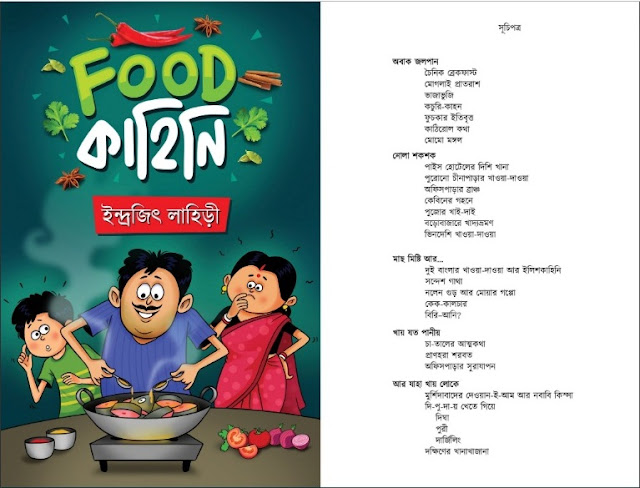
And Food Kahini is born. Author Indrajit Lahiri is third from right.


#FoodKahini #KolkataFoodGuide


If you liked reading the post, you may visit this blog's Facebook page (click on the link) and hit the 'Like' button to stay connected with the future updates on this blog and more on the page.

Monday, August 13, 2018

A police library with a difference

Today being National Librarian’s Day, I wish to talk about a new library that charmed me.

I came to know of it from a Facebook post of Kolkata Police. Known as Kolkata Police Museum on Google Maps, its full name is Kolkata Police Museum, Library and Cafeteria. It’s located at 112 Ripon Street (on the left approaching Wellington).

I visited it with three friends who got interested hearing of it (two of them read the Facebook post too). The museum is small and spread over two floors. Its main attraction is arms seized by police from various periods of history dating back to pre-independence era.


Photograph by Arnab Banerjee

It shows the evolution of the police uniform since the colonial times. The winners of various awards/ honours of police are listed. It states that Natha Singh was the first Indian to win a traffic roll of honour and he won honours in two consecutive years, 1938 and 1939. A section familiarizes with various badges of the ranks of police which is an important civil information.


The history of the house is interesting too. The second prince (Mejokumar) of the erstwhile Bhawal Estate, who is popularly known as 'Sanyasi Raja' (The monk king), thanks to the popular Bengali movie of the same name made on him, fought the famous Bhawal Monk case from this house. It is regarded as one of the most extraordinary cases ever fought in Indian judicial history which took place in 1933-1936. As it happened, a monk came to the estate and claimed himself to be the Mejokumar who was known to have died eleven years back, and demanded his share of the estate.

Available documents show that it was the residence of Calcutta High Court Barrister RS Tweedle in 1874. After changing hands it landed with lawyer SN Matilal (in 1912) whose daughter Sarajubala Devi was married to the first prince of the Bhawal estate. It went to be part of the estate thereafter.

The house was decided to be demolished given its pathetic condition at a point of time. Kolkata Police took it as a challenge to restore it, and I must say they have done an exemplary job! Post the painstaking restoration, it was declared a 'Restored Heritage Building of the City' by INTACH. 

Coming to the library. It took me by surprise by the kinds of books in its collection as it completely beats the perception of a police library. I later realised it was by design, thanks to the Commissioner of Police Mr Rajiv Kumar, as it has been envisioned as a centre for police-citizen connect. The CP is so attached to it that it is said to be his second home and he is often seen there. The surprise element is that it has a wide collection of books for all the members of a family, from the junior to the seniormost. The fiction section is amazingly robust with admirable collection of classic literature, juvenile literature and classic thrillers.  The non-fiction range is pretty good too, including study books in various disciplines like finance and management. There are many Bengali titles too, both in fiction and non-fiction. Noticed the now popular book on fascinating cases of Kolkata Police written by senior police officer Supratim Sarkar, titled Goendapith Lalbazar (The English translation named ‘Murder in the City’ is available too). Before it became a book, the stories were being published in the Rohoshyo Robbar series on Kolkata Police Facebook page and they gradually whipped up a huge following.  

The library has over ten thousand books.

At the end of our tour of the library, what blew my mind was the extensive collection of comic books in English to hook the youngest readers. Imagine a police library keeping a huge collection of Tintin and Asterix, Marvel and DC!!

As Sub-Inspector S Sharma, the friendly gentleman who acquainted us through the library, told us, it is open seven days a week, 11 am to 7 pm. However, the best time is weekend as visitors are much less. They encourage one to come with the whole family and spend a good number of hours there. To help the purpose, there’s a cool cafe, interestingly named Off Duty Delights, which serves (non-alcoholic) beverages and a good range of snacks. We liked the iced tea. For the overall feel, one of the friends compared it to the British Council Library.


Iced tea

The membership fee is Rs 800 per annum plus Rs 100 as a one-time cost of membership card. You can take books or DVD or both and keep upto two books for a maximum of four weeks.


#NationalLibrariansDay #Library #Museum #Heritage #History


If you liked reading the post, you may visit this blog's Facebook page (click on the link) and hit the 'Like' button to stay connected with the future updates on this blog and more on the page.

Monday, January 25, 2016

An afternoon with Christine Manfield in AKLF

It was the closing day of the well-organised Apeejay Kolkata Literary Festival (AKLF) which took place at various venues including Oxford Bookstore, Victoria Memorial, Town Hall steps and Tolly Club, covering a wide range of subjects in standalone or book release-linked discussions over 14th to 17th January.

The first session of the event was the release of the new book ‘A Personal Guide to India and Bhutan’ written by Australian Masterchef, food and travel writer Christine Manfield, by veteran journalist Vir Sanghvi, followed by a conversation between the Masterchef,  him, musician and food writer Nondon Bagchi and chef Sharad Dewan of The Park, which was the venue. It was succeeded by showcasing Christine’s book ‘Dessert Divas’ with Meera Syal and a demo of one of the desserts from the book.

Before proceeding further, a few facts about Christine Manfield:
  1. She is deep into food tourism and has been conducting food trips to India for years. She has been travelling to the country by its length and breadth for the last 20 years. Her coffee table book ‘Tasting India’, which is said to be a delectable cross between a coffee table book and a travelogue, is an outcome of this.
  2. Use of spices is her forte. Her favourite spices include chilli (first in order), turmeric, saffron and mustard seed. No wonder she is known as Mistress of Spices.
  3. She can’t live without rice and chilli. So much so that she carries chilli to places that don’t grow them.
  4. When she’s at home, she shops daily and doesn’t like stocking up for days. Sounds like a quintessential Bengali habit? There’s more to relate for Bengalis. Her Bengali favourites include luchi, shukto (she finds it really light and cleansing) and kochuri on the streets.
  5. Though she’s been a guest chef on the Masterchef Australia, she doesn’t think such ‘game shows’ are the right platform to learn to be a good cook or chef.

Reference: Her interview in t2 by Samhita Chakraborty in 2011.

Back to AKLF. I regret turning up late at the well-attended first session. But the short while I witnessed, was thoroughly enjoyable. Christine is good to listen to. She is well-spoken and articulate and has a good sense of humour. Because of her long experience of India, she knows Indian food by heart.

(Left to right) Christine Manfield, Nondon Bagchi, Vir Sanghvi and Sharad Dewan

The Q&A session that followed was interesting too. An old gentleman asked why a nation’s cuisine changes when it crosses the nation’s borders. The reference was to Chinese food which as he had experienced and heard, was bland in China and very unlike what is available by its name in India, even if Chinese cooks make it. Vir said he didn’t agree to the blandness thing completely because food in China has a wide variation in taste. While food in Peiking is bland, Hunan or Szechwan food are spicy. Nevertheless, the question was addressed.

The beginning of the Q&A session

Sharad said the similarity in taste depends a lot on the water. One of the things a dish derives its taste from is water and as that varies with a change in geography. So the taste of food changes too, no matter how authentically it is attempted to prepare.

Christine’s view was that a cuisine in the first place has to appeal to the people having it. So the taste of a cuisine can change in different corners of the world to some extent to adjust to local taste.

Nondon shared an anecdote of his younger days. He was in Chennai on a trip and became broke towards the end of the trip. So they had to survive on cheap local food. He still remembers the sambhar he had there. Back to Kolkata, he has had sambhar at many places cooked by south Indian chefs, but it has never been the same. It is impossible to replicate the original taste far away from an area.

 Interaction with audience

In this context, here is a word on the ‘Kolkata Chinese cuisine’. The early Chinese cuisine of Kolkata, served in restaurants like Nanking in the 20s’ was subtly flavoured, close to what it is in China. But with time, the taste evolved to suit local taste more. Thus green chilli sauce was born, marrying Chinese and Indian flavours, in the hands of a Chinese gentleman living in the city. It was followed by other sauces like chilli garlic and hot garlic which have nothing to do with China but everything to do with Kolkata’s palate.

There was a supposedly short tea break between the sessions. But given the wide array of items served- finger food and dessert, and the large attendance, the queue was slow to move and seemed never to end. There were chicken breast (mini) cutlet (with tartar sauce), small mangsher shingara with tentuler chutney (tamarind chutney), Joynagarer moa, sandesh and mini lemon tart among other things. Not surprisingly, with such a delectable spread the short break was getting longer and the moderator lady had to make repeated calls to the audience to be back on seats.

 Mangsher Shingara (left), chicken breast cutlet (centre down), Joynagarer Moa (Centre up), ), sandesh (right up)
and mini lemon tart (right down)

In the next session, where Christine’s new book ‘Dessert Divas’ was showcased, she was introduced as ‘The queen of decadent desserts’. In Christine’s words, a dessert is ‘seduction through the eyes’. The book is divided into six chapters and four seasonal sections including summer desserts, winter desserts and spring desserts. This session saw a full house.


Over the next half an hour or so, we saw the title pages of the desserts in the book projected on the screen at the right and Christine described one by one. I must mention, the names are imaginatively and wittily given.


(Left to right) Christine, Meera Syal and Sharad Dewan

The Summer Desserts section has desserts like ‘I go to Rio’, a banana-based dessert- ‘Bananarama’, named after a popular rock band, ‘Bite the Pillow’ (The pillow is of marshmallow with lemon tart at the centre). There is one called ‘Sticky Fingers’ made with pomegranate, fig and organic honey. The pomegranate seeds are soaked in the honey and the longer they are in the honey, the better they taste. There was another one called ‘F.I.G. J.A.M.’, which seemed it meant the obvious, but the audience had a good laugh when she expanded the name. It was …..'F**k, I’m good, just ask me'.

“Apples are good in winter”, she said. So the Winter Desserts section had many apple-based preparations. ‘Bithday Suit’ was one of the desserts and the demo that followed was of this. ‘Queen Bee’ and ‘Adam’s Downfall’ were two others.

Spring Desserts had names like Rock the Kasbah, Strawberry Fields Forever, Menage a Trois and Mocha Bomb (A chocolate mousse on the bed of espresso ice cream).

She moved on to the table at the left for the demo of ‘Birthday Suit’. The printed recipe had been circulated to every audience member before the session. She explained every step in great detail and much of her interaction with Meera happened at this stage. It was made of meringue puff, white chocolate mousse, lemon curd (made of egg yolk, castor sugar, lemon juice and cold, unsalted butter), raspberry and raspberry sauce.


Session over, the audience was privileged to taste it. I liked it because of the tangy raspberry sauce.


#AKLF #ChristineManfield #DessertDivas


If you liked reading the post, you may visit this blog's Facebook page (click on the link) and hit
the 'Like' button to stay connected with the future updates on this blog and more on the page.

Friday, January 15, 2016

The curtain raiser of Apeejay Kolkata Literary Festival 2016, 14th-17th January

January is the season of book fair and literary meets in Kolkata. And AKLF is the first literary meet to roll. Organized by Apeejay Surendra Group and Oxford Bookstore, it had a curtain raiser with a heritage walk on College Street, the city’s book and academic hub, on the last Sunday morning (10th January). The walk was organized by Streets of Calcutta. Rangan Dutta, a well-known travel blogger and writer, led the walk. I joined it at College Square and continued till the end at Swami Vivekananda’s residence. About seventy heads met and took the walk.

The famous swimming club at College Square, named College Square Swimming Club, was founded in 1917 by a group of seventeen people headed by Pramotho Nath Ghosh with the objective of imparting scientific training of swimming and development and promotion art of life-saving in water for the society.

College Square

Calcutta University was the first institution in Asia to be established as a multidisciplinary and secular Western-style university, was established in 1857.

Calcutta University

We were walking along College Street which is the largest book market in the country and also the largest second-hand book market in the world.


The building at the crossing of Bankim Chandra Chatterjee Street where the legendary Indian Coffee House, the heritage coffee shop, is located

The college which was founded as Hindoo College in 1817 was rechristened Presidency College in 1855 and turned into Presidency University by the state government in 2010.

Rangan Datta (in blue) with the participants in Presidency University

There is this plaque near the main gate in the memory of its gate-keeper Ram Eqbal Singh (a harmonious name!) who died chivalrously defending his college in the riots of 1926.


There is this statue, hardly noticed, at the College Street-MG Road junction (diagonally opposite erstwhile College Street market). It is of Rai Kristodas Pal Bahadur who was a renowned journalist (1838-1884) and a legislator. He was awarded the Most Eminent Order of the Indian Empire (CIE). It was an order of chivalry founded by Queen Victoria in 1878.

The statue of Rai Kristodas Pal Bahadur

The old College Street market was demolished to make India’s first book mall by the state government. The showpiece mall named Barnaparichay (The name of the first book in Bengali), perfectly fitting this book-loving city, was conceived in 2007 to be built under PPP. Due to some reasons, the construction is still not complete and only a part of it is operational now. Its main entrance has been kept intact due to the heritage status.

College Street market


The famous  Laha Bari- a house aged more than 200 years, belongs to the Laha family who bought it from another Bengali family. Well known for its Durga Puja and numerous Bengali and Hindi film shoots.

Laha Bari


Thanthania Kalibari, one of the famous temples of goddess Kali, was founded by Shankar Ghosh in 1803, a mentioned in the temple building itself. However, according to another inscription in the temple, its foundation was laid in 1703. The deity is called Siddheshwari and it is made of clay.

Thanthania Kalibari

We stopped by this old sign of a tram stop which has surprisingly withstood eras. An old man in his late seventies sitting in a shop near it was telling us his experience of it seeing our enthusiasm. He said it was already built while he was a small kid. Rangan and Shaikh Sohail, a heritage enthusiast in the group tried to second-guess its age and agreed that it must be more than a hundred years.

 An old tram stop sign from the British era


The Sadharan Brahmo Samaj was formed in a public meeting of Brahmos held in the Town Hall of Calcutta on 15th May 1878. ‘Brahmo Samaj’ means a community of men who worship only Brahma or the Supreme Spirit of the universe.

 Sadharon Brahmo Samaj

The culmination of the walk turned out to be the biggest highlight. We visited the home of Swami Vivekananda which has been turned into a museum by Ramakrishna Mission. The entry ticket costs Rs 10 and you need to leave your shoes in the racks outside. This tranquil place on the busy Bidhan Sarani was Swami Vivekananda's home throughout his childhood and early youth. The large house was built by his great-grandfather Rammohan Dutta. All the furniture and accessories used by him and his family are tastefully preserved and displayed. The anecdotes of his childhood are illustrated through life-size statues.

The condition of the house deteriorated terribly over time. Finally, in 1999, it was acquired along with an adjacent plot by Ramakrishna Mission. It was painstakingly restored through great preparation and research and monstrous efforts with the help of Archeological Society of India over 1999-2004 and made into a museum and cultural centre. It was thrown open for public visit in 2004. There is a short audio-visual played inside which depicts the truly historic restoration. A large auditorium is being built at the backyard now.

The residence of Swami Vivekananda

The adjacent building, now an education centre run by the mission

There was an unofficial sweet ending at Girish Chandra Dey & Nakur Chandra Nandy, the legendary sweet shop at Hedua that specialises in sandesh, not far from the said museum. Indrajit Lahiri and Soumya Shankar Ghosal of Streets of Calcutta treated us with a sandesh each. The naram paak (soft made) nolen gur sandesh handpicked by Indrajit, a food blogger by passion, was sublime to put it in short.


To know more about AKLF, visit its website (Link given in the first line), its Facebook page and Twitter handle.

#AKLF #AKLF2016 #HeritageWalk #CollegeStreet #KolkataHeritage #Kolkata
  
  
If you liked reading the post, you may visit this blog's Facebook page (click on the link) and hit
the 'Like' button to stay connected with the future updates on this blog and more on the page.

Wednesday, November 11, 2015

Kalkatta by Kunal Basu

When about two years back I read, probably in Anandabazar Patrika, that renowned author Kunal Basu had shifted his base to his city of origin- Kolkata, and henceforth would divide his time between UK (where he teaches in Oxford University) and this city, I was elated as a Kolkatan to see one of the city's brightest minds back home. At that time he just started research on his next novel set in Kolkata and centred around a gigolo. The novelty of the subject fanned my curiosity about the book and finally now it is coming out from Pan Macmillan India as Kalkatta (The way non-Bengalis pronounce the name of the city).

The book title has an engaging tagline- Every city has its secrets.

This video about the book, that I came across from a Facebook post by blogger friend Anindya S Basu, got me more hooked to it. It is a monologue of the author shot largely outdoor in various locations in Kolkata and his home, and a charming preface of the story. 

When I started writing this novel, the question that was foremost on my mind was how do I bridge the gap between me, the author, and Jamshed, the gigolo. And I thought the best way would be to write the novel in first person. To try to see Kolkata through the eyes of Jamshed rather than through the eyes of me.”- Kunal Basu says in the video.

Watch it here.


Looking forward to reading the book. It is quintessentially Kolkata and brings out lives from a part of the city I guess hardly dealt with in contemporary English fiction.


#Kalkatta #KunalBasu #KunakBasuBooks #KolkataEnglishfiction


If you liked reading the post, you may visit this blog's Facebook page (click on the link) and hit the 'Like' button to stay connected with the future updates on this blog and more on the page.