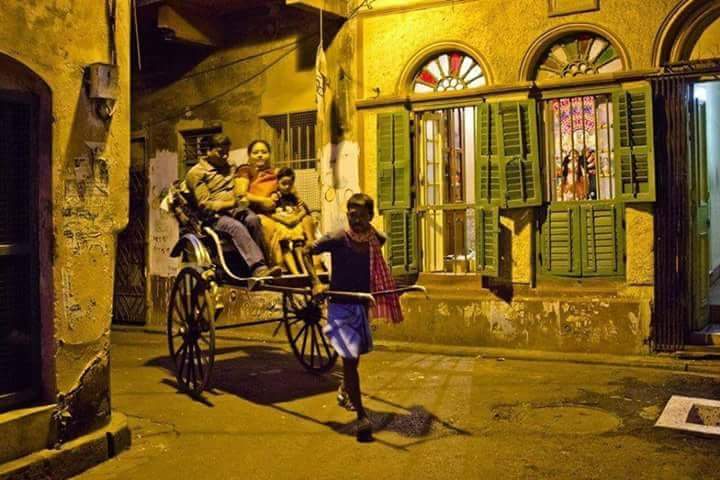
The flavour of Kolkata

The flavour of Kolkata
The city is known for its old alleys. One such is shot by Atanu Pal.
Showing posts with label Literature. Show all posts

Tuesday, April 16, 2019

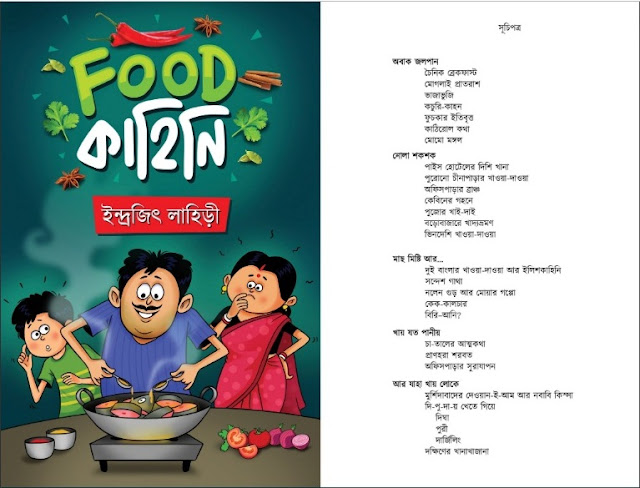
Food Kahini hits the bookstores

"Ritu-da (Rituparno Ghosh) used to call her by the name of a food"

"Shut up!"

Mir was going to spill the beans about the name as food was the theme of the conversation with the guests at the book launch and actor Sudiptaa Chakraborty tried to dissuade him in vain. Well, the pet name that Rituparno gave her in their very first meeting was ‘Gutke kochuri’ (A small version of kochuri or kachauri). Let’s be a bit fair to Sudiptaa and not get into what actually prompted him in giving that name.

It was the evening of the launch of Food Kahini, the food book that turned well-known Kolkata food blogger Indrajit Lahiri into author. And it happened in style. The starry April evening at Peerless Inn had composer-singer-lyricist Anupam Roy, actor Aparajita Auddy and singer Lagnajita Chakraborty apart from Sudiptaa as guests and as the cherry on the cake, Mir was the host. Mir, incidentally, plays the ‘Bhaipo’ (Nephew) in the food-based web series ‘Foodka’ with Indrajit in the titular role of the uncle who is a knowledgeable foodie. It is into its third season (Available on YouTube).

Anupam sharing about his weakness for sweets

Mir had already asked Anupam about his foodie side and shared with us his deep love for sweets. He also asked the famous composer in jest what all he keeps in his fridge since his romantic songs often have names of vegetables (Like dry spring onion). It was followed by Aparajita who confessed her obsession for khichudi (Khichdi). She shared a childhood incident, with an annual occurance, where her parents used to find her sitting on the road, right by an open drain, without a care, just to eat the ‘bhog’ (Prasad) along with many others, served in a local puja. The banter, peppered with Mir's wisecracks, made for a fun time.

Aparajita talks of her obsession for khichudi with her trademark laughter

When it was Lagnajita’s turn at the end, she offered a private story on Anupam’s sweet connection where the venue was her home. Though she kept on insisting that it was harmless, it was enough to embarrass Anupam, albeit in good spirit.

Lagnajita spilling the beans

Coming to the book, it’s every blogger’s secret dream have a book to his/ her name and Indrajit was no exception. Though his blog Moha Mushkil is primarily in English, it has a section of Bengali posts and I’ve often told this friend of mine to write more in Bengali since it’s the language that befits his humorous and free-flowing writing style. Good that Food Kahini is in Bengali and comprises of his writings on various segments of foods that Kolkata is collectively known for all over the world- from the Chinese breakfast of Tiretta Bazar to the famous born-in-Kolkata kati roll to momos. In different chapters, it talks of the food at Chinatown, the brunch at 'Office para' or Dalhousie area- the central business district, the heritage cabins of the city and a foodwalk at Burrabazar which is more known as one of Asia’s largest trading hubs. It has many other attractions in the other chapters and goes beyond Kolkata to other districts of Bengal. Needless to say, it promises to be a fun read.
And Food Kahini is born. Author Indrajit Lahiri is third from right.


#FoodKahini #KolkataFoodGuide


If you liked reading the post, you may visit this blog's Facebook page (click on the link) and hit the 'Like' button to stay connected with the future updates on this blog and more on the page.

Sunday, November 06, 2016

Apeejay Bangla Sahitya Utsob- a heritage bus tour

I love to explore the heritage of Kolkata. So when this invitation came from the Apeejay group for a literary heritage tour as a curtain-raiser to their Apeejay Bangla Sahitya Utsob (a Bengali literature festival) organized by Oxford Bookstore, the heritage book den and Patra Bharati, an old publication house, I agreed to it. It was a tour of the houses of some of the most illustrious names in Bengal’s literary history.

A Sunday afternoon saw a bunch of bloggers and social media enthusiasts hop on a small AC bus from Apeejay House, Park Street. It started for the tour around 2.30 pm. Another bus carried mediapersons. It was fun to be in the company of fellow bloggers, chatting away the time in the bus amid our usual banter. RJ Roy, who I know since long before he became popular on radio (the Orkut days), was also with us.

Our first stop was the residence of Raja Rammohan Roy which was later converted to Calcutta Police Museum. It is located at 113 Acharya Prafulla Chandra Road (APC Road) before Manicktala crossing when approached from Sealdah.

Calcutta Police Museum. Photograph by Subhadip Mukherjee.

Eminent journalist, author and scholar Ranjan Bandopadhyay introduced us to the history of this place. Tridib Kumar Chattopadhyay, MD, Patra Bharati also spoke briefly and Swagat Sengupta, CEO, Oxford Bookstore and Director, Apeejay Bangla Sahitya Utsob spoke about the literary festival.

(Left to right) Swagat Sengupta, Ranjan Bandopadhyay, Tridib Kumar Chattopadhyay

The house was built around 1814 on a five acre plot with three ponds. Rammohan used this house to entertain his European friends and hold meetings with his associates and collaborators. The house was built and furnished in European style as described by Fanny Parkes, a well-known travel writer of nineteenth century.

Rammohan auctioned this house to organize funds for his departure for England in 1830. The government of West Bengal rented this house to re-locate Sukia Street police station in 1874. The government acquired this property in 1918 and till 1990s, various offices and senior officers’ quarters have been accommodated in the premises after the police station was shifted again. In 1996, Calcutta Police Museum was inaugurated in the house.

It has been a long time wish for me to visit the museum. It is a place to know the rich history of the city police right from pre-independence era. It depicts many well-known incidents from the history pages as well as the last few decades with preserved material belonging to the said incidents (including a large variety of arms recovered down the decades). There are dedicated officers of Kolkata Police who take the visitors through the exhibits.

The museum is open Monday-Saturday, from morning till about 5.30 pm and closed on public holidays. Entry is free. It is an ideal place to visit for children who have studied the freedom movement of Bengal in history books.

Unfortunately, photography is prohibited inside the museum and special permission is required to shoot. Hence I couldn’t take pictures to post here.

Among the interesting exhibits are the book bomb sent to chief presidency magistrate of Kolkata DH Kingsford in 1908, made by freedom-fighter Hemchandra Das, and Mauser pistol which fired both in short as well as long range (fitted in the body of a rifle, it used to fire like one) and could be easily concealed as a toy in a wooden case.

It also displays the hierarchy of the police and displays the badges which are worn on the uniform indicating different positions. The commissioner’s badge has a sword and a baton crossed along with stars. Every single badge is noticeably different for concerned and knowledgeable people to make out which position it is for. There is a list of all the city police commissioners right from the first till the previous one along with photographs. The first ever Indian commissioner was Surendra Nath Chatterjee (1947-1951).

An interesting bit of information to note was that the women’s section in Kolkata Police was started as long back as 1949 with nine sub-inspectors and thirty four assistant sub-inspectors.

The house also has the quarters of a senior police officer. I couldn’t resist the temptation to shoot this statue of a fairy in the middle of this manicured garden on the right hand side of the museum where the quarters are located, before I was told that photography was prohibited there too.


 The entrance seen from inside

We couldn’t stay for long. It would take at least two hours to explore the entire collection of the museum. I have to come back here.

We walked to our next destination Rammohan Library which was almost a stone’s throw. It was closed that day, so we couldn’t step inside. It’s located at 267 APC Road. Noted travel blogger and friend Rangan Dutta shared the history of the place briefly to the participants but I completely missed it.  It was founded in 1904 in memory of Raja Rammohan Roy to support and develop reading habit and create a cultural milieu. The library has a collection of rare books and magazines along with arrangement for research, a dedicated section for children and adolescents, does literary meets and has a permanent exhibition on Rammohan.

Rammohan Library

We hopped on to the bus and went down near Rajabazar Science College. The destination was noted author and publisher Upendrakishore Ray Chowdhury’s house. It’s on Garpar Road adjacent to Calcutta Deaf & Dumb School which is a few metres away from the science college on the opposite side of the road. It’s a white-coloured building at 100A Garpar road which has been declared a heritage building by The Kolkata Municipal Corporation. The house is not open for public visit.

The residence of Upendrakishore Ray Chowdhury

This was also the house where Upendrakishore’s son, famous children’s author Sukumar Ray lived all his life and his son, globally acclaimed director Satyajit Ray spent the early years of his childhood. Leela Majumdar, Upendrakishore’s niece and a famous author of children’s literarture also lived here. So, it is a rare address associated with three generations of literary and cultural legends who are widely known for laying the foundation of children’s literature in Bengali. Upendrakishore ran his publishing house U Ray & Sons which published the legendary Bengali children’s magazine Sandesh from this address. It also houses a school, Atheneum Institution which was started in 1931.

The busts of (left to right) Upendrakishore Ray Chowdhury, Sukumar Ray and Satyajit Ray

The bus then took us to Hrishikesh Park through Sukia Street. The residence of legendary educationist, author, reformer and philanthropist Ishwar Chandra Vidyasagar is located behind the park. It’s a nicely-built two-storied house with a long balcony along two sides of the building with an adjacent lawn having an open-air stage at one side. Though this is an IGNOU centre now, it wasn’t open that day.

The residence of Ishwar Chandra Vidyasagar


Rangan Dutta (centre) with the participants

Our last stop was Bangiya Sahitya Parishad at 243/1 APC Road. Unfortunately this was closed on that day too. Founded in 1893 for promoting Bengali literature (including translating literary work in other languages to Bengali), it was situated in the house of Binoy Krishna Deb, the first president, at Raja Nabakrishna Street. After several shifts, it came to the present address on a land donated by Maharaja Manindra Chandra Nandi of the royal family of Cossimbazar. It was first named The Bengal Academy of Literature which was changed to the present name in 1894. Rabindranath Tagore was one of the first vice presidents of this academy.

 Bangiya Sahitya Parishad

I wasn’t aware that the homes of several luminaries of Bengali education and literature were located such close to one another in north Kolkata. My sincere thanks to Apeejay Bangla Sahitya Utsob for the experience, especially for the police museum.

Apeejay Bangla Sahitya Utsob was held at Oxford Bookstore on 21st and 22nd October 2016.


#ABSU2016 #Heritage #History #BengaliLiterature #KolkataPolice


If you liked reading the post, you may visit this blog's Facebook page (click on the link) and hit the 'Like' button to stay connected with the future updates on this blog and more on the page.

Friday, July 15, 2016

The upcoming Bangla releases

After a dry stretch, the Friday of 22nd July till the end of August is going to see four important Bangla releases. Kolkata Curry takes a peek into them.

Khawto- This 22nd July release is an erotic thriller by Kamaleswar Chander Pahar Mukherjee starring Prosenjit, Raima and Paoli. Ronodeep Bose and Tridha Chowdhury play a young romantic couple. Prosenjit plays an author which seems to be a grey character. The Bengali audience has a fondness for thrillers, and here’s another one to quench their thirst. Khawto is dark and bold, which lends it a novelty. It explores love, lust, infidelity and betrayal. Need more reasons to check it out?

The Khawto poster. Source: Facebook

Eagoler Chokh- Releasing this Independence Day week, it’s a crime thriller for the adult audience by Arindam Sil with police detective Shabor Dasgupta back as the investigator. It's the second instalment of the Shabor franchise penned by Shirshendu Mukhopadhyay which tasted success on screen with its first outing Ebar Shabor in January 2015. Saswata plays Shabor and the cast includes Jaya Ahsan, Anirban Bhattacharya (of last year’s Arshinagar) in a pivotal role, June, Payel and Arjun Chakraborty. Arunima is said to have sizzled in a bar song sequence.

In case you wanted to read a review of Ebar Shabor or revisit it, find it on this blog here.

Saswata as Shabor in Eagoler Chokh. Source: Facebook page 
of Shree Venkatesh Films

Hemanta- Releasing on the same day as Eagoler Chokh. It’s Anjan Dutt’s adaptation of one of Shakespeare’s most cultivated creations- Hamlet. Stars Parambrata in the title role, Saswata as Claudius, Gargi as Gertrude (Hamlet’s mother), Jisshu as Horatio (Hamlet’s friend) and Payel as Ophelia, the love interest. That’s a strong cast! The film is set in today’s Bengali film industry and explores the issues plaguing it, including the financing by chit funds. It will be interesting to see Anjan back with this classic tale after two back to back Byomkesh films.

 The first look poster (Source: Parambrata's Facebook page)

Shaheb Bibi Golaam- Releasing 26th August. A musical thriller by film critic-turned-filmmaker Pratim D Gupta who you have been reading in The Telegraph (in t2) for long. This is his second full-length feature film as a director (after Panch Adhyay in 2012). Its only similarities with the classic novel by Bimal Mitra and the eminent films based on it in Hindi and Bengali are its title and the fact that it has a Shaheb (an Anglo-Indian), a Bibi (a housewive) and a Golaam (a taxi driver) in the central characters. Anjan Dutt plays Jimmy, an Anglo-Indian contract killer, Swastika plays Jaya, a housewife who is breaking bad and Ritwik plays taxi driver Javed, who “is a romantic at heart, who doesn't let his profession get in the way of his passion” as per the Facebook page of the film. It will present an unusual romantic pair in Ritwik and Parno. The film had been denied a certification by CBFC on account of its erotic content and got itself recently cleared by the appellate committee. The Mon bhalo nei song sung and composed by Anupam is gathering some encouraging buzz.

The first look poster

#Khawto #EagolerChokh #Hemanta #ShahebBibiGolaam #BanglaCinema #BengaliCinema


If you liked reading the post, you may visit this blog's Facebook page (click on the link) and hit the 'Like' button to stay connected with the future updates on this blog and more on the page.

Sunday, May 08, 2016

A unique Bengali new year calendar

I read in Ei Samay, the Bengali daily, a few days ago that a Bengali new year calendar was printed in thirty thousand by a leading cake shop chain, and it went out of stock within two weeks of the Bengali new year day this year (14th April) or less, thanks to the demand from customers among whom it was distributed.

Drooling over a calendar of Bengali new year (it’s 1423), something that most of us don’t follow except for certain times of the year! Also, the creative aspect of such a calendar is generally not worth writing home about. So this one had got to be something extremely special, I thought.

The name of the creative agency (Mayurakshi) and that it was for a leading cake shop chain rang a bell. So when I was in Mio Amore earlier this week and had a fleeting glance of someone walking out with a sophisticated rolled up calendar, I asked a salesman whether they had come up with a new year calendar. As he answered in affirmative, I asked whether it was for a price. He embarrassedly said no, and picked up and handed over one to me. It was a wonderful reward from the chain to me for being a loyal customer for many years.


It is a theme calendar based on Satyajit Ray and the legendary sleuth created by him- Feluda, produced in association with the Ray family and Ray Society, with a well-worded foreword by Sandip Ray. It celebrates the fiftieth year of Feluda’s debut in Bengali literature. Sandip has revealed how Feluda had gradually developed noticeable resemblance in psychological traits and similarities in physical traits and dress sense with his creator.

The calendar presents the versatile creative genius of Ray, from writing, illustration and book designing to various aspects of filmmaking.

It starts with the manuscript of the first Feluda story- Feludar Goendagiri along with its published illustration and the book cover design of Joy Baba Felunath.

The manuscript of Feludar Goendagiri

It then walks into his world of filmmaking where we see the first page of the Sonar Kella script, Ray’s work on the production design (like the sketch of Feluda’s room in Sonar Kella), costume design and character sketches.

The first page of Sonar Kella script (Middle at the left)

The sketch of Feluda’s room in Sonar Kella

The character sketch of the knife thrower Arjun (Right) and the design of the dart board in Joy Baba Felunath

Costume design for Sonar Kella

There are stills of the making of the two Feluda films made by Ray showing him busy in the shooting with the actors.

The maestro earnestly believed in getting every small detail right in his films and used to be personally involved in ensuring the same. The shooting stills of Joy Baba Felunath in the calendar bear ample testimony to it. How many of us know that the freeze-frame at the end of Joy Baba Felunath showing the title written on stone at the Beneras ghat was created by Ray himself?

Ray adding touches to the Durga idol in Joy Baba Felunath 

The master writing the title on stone in Benaras which we see in the 
freeze-frame at the end of Joy Baba Felunath 

My sincere thanks to Mio Amore for creating this collector’s item where they have cheered for the Bengali intelligence and creativity.


#BengaliNewYear #SatyajitRay #Feluda50 #FeludaFilms #MioAmore


If you liked reading the post, you may visit this blog's Facebook page (click on the link) and hit the 'Like' button to stay connected with the future updates on this blog and more on the page.

Monday, January 25, 2016

An afternoon with Christine Manfield in AKLF

It was the closing day of the well-organised Apeejay Kolkata Literary Festival (AKLF) which took place at various venues including Oxford Bookstore, Victoria Memorial, Town Hall steps and Tolly Club, covering a wide range of subjects in standalone or book release-linked discussions over 14th to 17th January.

The first session of the event was the release of the new book ‘A Personal Guide to India and Bhutan’ written by Australian Masterchef, food and travel writer Christine Manfield, by veteran journalist Vir Sanghvi, followed by a conversation between the Masterchef,  him, musician and food writer Nondon Bagchi and chef Sharad Dewan of The Park, which was the venue. It was succeeded by showcasing Christine’s book ‘Dessert Divas’ with Meera Syal and a demo of one of the desserts from the book.

Before proceeding further, a few facts about Christine Manfield:
  1. She is deep into food tourism and has been conducting food trips to India for years. She has been travelling to the country by its length and breadth for the last 20 years. Her coffee table book ‘Tasting India’, which is said to be a delectable cross between a coffee table book and a travelogue, is an outcome of this.
  2. Use of spices is her forte. Her favourite spices include chilli (first in order), turmeric, saffron and mustard seed. No wonder she is known as Mistress of Spices.
  3. She can’t live without rice and chilli. So much so that she carries chilli to places that don’t grow them.
  4. When she’s at home, she shops daily and doesn’t like stocking up for days. Sounds like a quintessential Bengali habit? There’s more to relate for Bengalis. Her Bengali favourites include luchi, shukto (she finds it really light and cleansing) and kochuri on the streets.
  5. Though she’s been a guest chef on the Masterchef Australia, she doesn’t think such ‘game shows’ are the right platform to learn to be a good cook or chef.

Reference: Her interview in t2 by Samhita Chakraborty in 2011.

Back to AKLF. I regret turning up late at the well-attended first session. But the short while I witnessed, was thoroughly enjoyable. Christine is good to listen to. She is well-spoken and articulate and has a good sense of humour. Because of her long experience of India, she knows Indian food by heart.

(Left to right) Christine Manfield, Nondon Bagchi, Vir Sanghvi and Sharad Dewan

The Q&A session that followed was interesting too. An old gentleman asked why a nation’s cuisine changes when it crosses the nation’s borders. The reference was to Chinese food which as he had experienced and heard, was bland in China and very unlike what is available by its name in India, even if Chinese cooks make it. Vir said he didn’t agree to the blandness thing completely because food in China has a wide variation in taste. While food in Peiking is bland, Hunan or Szechwan food are spicy. Nevertheless, the question was addressed.

The beginning of the Q&A session

Sharad said the similarity in taste depends a lot on the water. One of the things a dish derives its taste from is water and as that varies with a change in geography. So the taste of food changes too, no matter how authentically it is attempted to prepare.

Christine’s view was that a cuisine in the first place has to appeal to the people having it. So the taste of a cuisine can change in different corners of the world to some extent to adjust to local taste.

Nondon shared an anecdote of his younger days. He was in Chennai on a trip and became broke towards the end of the trip. So they had to survive on cheap local food. He still remembers the sambhar he had there. Back to Kolkata, he has had sambhar at many places cooked by south Indian chefs, but it has never been the same. It is impossible to replicate the original taste far away from an area.

 Interaction with audience

In this context, here is a word on the ‘Kolkata Chinese cuisine’. The early Chinese cuisine of Kolkata, served in restaurants like Nanking in the 20s’ was subtly flavoured, close to what it is in China. But with time, the taste evolved to suit local taste more. Thus green chilli sauce was born, marrying Chinese and Indian flavours, in the hands of a Chinese gentleman living in the city. It was followed by other sauces like chilli garlic and hot garlic which have nothing to do with China but everything to do with Kolkata’s palate.

There was a supposedly short tea break between the sessions. But given the wide array of items served- finger food and dessert, and the large attendance, the queue was slow to move and seemed never to end. There were chicken breast (mini) cutlet (with tartar sauce), small mangsher shingara with tentuler chutney (tamarind chutney), Joynagarer moa, sandesh and mini lemon tart among other things. Not surprisingly, with such a delectable spread the short break was getting longer and the moderator lady had to make repeated calls to the audience to be back on seats.

 Mangsher Shingara (left), chicken breast cutlet (centre down), Joynagarer Moa (Centre up), ), sandesh (right up)
and mini lemon tart (right down)

In the next session, where Christine’s new book ‘Dessert Divas’ was showcased, she was introduced as ‘The queen of decadent desserts’. In Christine’s words, a dessert is ‘seduction through the eyes’. The book is divided into six chapters and four seasonal sections including summer desserts, winter desserts and spring desserts. This session saw a full house.


Over the next half an hour or so, we saw the title pages of the desserts in the book projected on the screen at the right and Christine described one by one. I must mention, the names are imaginatively and wittily given.


(Left to right) Christine, Meera Syal and Sharad Dewan

The Summer Desserts section has desserts like ‘I go to Rio’, a banana-based dessert- ‘Bananarama’, named after a popular rock band, ‘Bite the Pillow’ (The pillow is of marshmallow with lemon tart at the centre). There is one called ‘Sticky Fingers’ made with pomegranate, fig and organic honey. The pomegranate seeds are soaked in the honey and the longer they are in the honey, the better they taste. There was another one called ‘F.I.G. J.A.M.’, which seemed it meant the obvious, but the audience had a good laugh when she expanded the name. It was …..'F**k, I’m good, just ask me'.

“Apples are good in winter”, she said. So the Winter Desserts section had many apple-based preparations. ‘Bithday Suit’ was one of the desserts and the demo that followed was of this. ‘Queen Bee’ and ‘Adam’s Downfall’ were two others.

Spring Desserts had names like Rock the Kasbah, Strawberry Fields Forever, Menage a Trois and Mocha Bomb (A chocolate mousse on the bed of espresso ice cream).

She moved on to the table at the left for the demo of ‘Birthday Suit’. The printed recipe had been circulated to every audience member before the session. She explained every step in great detail and much of her interaction with Meera happened at this stage. It was made of meringue puff, white chocolate mousse, lemon curd (made of egg yolk, castor sugar, lemon juice and cold, unsalted butter), raspberry and raspberry sauce.


Session over, the audience was privileged to taste it. I liked it because of the tangy raspberry sauce.


#AKLF #ChristineManfield #DessertDivas


If you liked reading the post, you may visit this blog's Facebook page (click on the link) and hit
the 'Like' button to stay connected with the future updates on this blog and more on the page.

Wednesday, November 11, 2015

Kalkatta by Kunal Basu

When about two years back I read, probably in Anandabazar Patrika, that renowned author Kunal Basu had shifted his base to his city of origin- Kolkata, and henceforth would divide his time between UK (where he teaches in Oxford University) and this city, I was elated as a Kolkatan to see one of the city's brightest minds back home. At that time he just started research on his next novel set in Kolkata and centred around a gigolo. The novelty of the subject fanned my curiosity about the book and finally now it is coming out from Pan Macmillan India as Kalkatta (The way non-Bengalis pronounce the name of the city).

The book title has an engaging tagline- Every city has its secrets.

This video about the book, that I came across from a Facebook post by blogger friend Anindya S Basu, got me more hooked to it. It is a monologue of the author shot largely outdoor in various locations in Kolkata and his home, and a charming preface of the story. 

“When I started writing this novel, the question that was foremost on my mind was how do I bridge the gap between me, the author, and Jamshed, the gigolo. And I thought the best way would be to write the novel in first person. To try to see Kolkata through the eyes of Jamshed rather than through the eyes of me.”- Kunal Basu says in the video.

Watch it here.


Looking forward to reading the book. It is quintessentially Kolkata and brings out lives from a part of the city I guess hardly dealt with in contemporary English fiction.


#Kalkatta #KunalBasu #KunakBasuBooks #KolkataEnglishfiction


If you liked reading the post, you may visit this blog's Facebook page (click on the link) and hit the 'Like' button to stay connected with the future updates on this blog and more on the page.


Saturday, May 16, 2015

A nostalgic Bengali poem

Came across this gem of a poetic creation in Bengali by the dear, versatile Rana Basu Thakur on Facebook, and couldn't resist the temptation of publishing it here. It took me back to my college days in early to mid nineties and elucidates love then and now. It was posted on 3rd March, 2014 in the notes section of his profile. Rana has many such gems in his treasure chest and this one is very close to his heart.

Tobuo Boshonto
Jetaam tokhon tomader baari
Chhilo naako driver aar ei meki luxury
Chhilo hridoygaami share er auto
Drutogaami fade howa albumer photo

Chhilo na IPL aar i-Pill er chaap
Chhilo ushno chhnowa aar hridoyer uttaap
Shei school leaving beeborno ekta scrapbook
Shei JU lobby te ekta hurried lajuk look
Haathe aanka card aar Wingsung fountain pen ey lekha cheethi
Anguler phnaake Chelpark kaali
Daamal diner chhatro rajneeti.
Chhilo na add me up on whatsapp, here's my BBM pin
Chhilo Milon da, Arun da aar AC'r canteen.

Dol bnedhe Shantiniketan
Aajo mone pore amar lekha tomar gaawa gaan
Khowai nodeer paare shei odbhoot moner dwondo
Jochhonaaye snaan kora aamro monjorir shugondho
Khore'r gaadaye pose diye tola chhobita
The morning after... 
Golapi dupatta aar bekaar premiker kobita

Nochiketa'r Nilanjana'r laal fitey shada moja,
Shumon'er shei Gariahaatar mor
Shilajit'er shopno dekha ghumer ghor
Parash pathor, chandrabindu aar amader shei gaaner ghota
Spring fest ey prothom gaanja aar ramp ey tomar prothom hnaata

Amar lekha tomar aanka St Xaviers green bench ey tee shirt becha
Sanskriti aar Xavotsav ey debating society aar dhoom naacha
Lake club ey regatta
VP tey bhel-batata.
Long walks in silence
Ankahee kuchh baatein that made no sense
The spring in our steps, the songs in our heart
The love that you can never ship from a flipkart

Roilo na kichhui baakita byaktigoto
Pore roilo khuchro likes aar random updates joto
Bhalo theko, bhalo besho eta aajo chaibo
Choley gechho tumi. Aami ekhanei thakbo.

Dekhlaam hothaath aaj jaanlaar baaire krishnochoora gaachhta

Boshonto.

Bodley gechho tumi…

Onekta


Photograph by Rana Basu Thakur

Photograph by Rana Basu Thakur

Photograph by Rana Basu Thakur

Yes, this is the same Krishnachoora tree (Gulmohar) you read about in the poem. A parting shot just for you from yours truly.

Now Byomkesh vs Byomkesh

The fictional detectives and truth seekers from Bengali literature seem to be engaged in an interesting power play. In the run-up to Feluda vs Byomkesh last year, the former's producer said Byomkesh was television material. After the release both set the box office on fire. Now the same production house has bought all the available Byomkesh stories to build a franchise over the next seven years (with one release a year), while the house currently making Byomkesh committed to continuing making it with one release a year.

Apparently the trigger for this aggression of the Feluda house was that the Byomkesh house is making a movie from another popular fictional series Kakababu (based on which the Feluda house has already made one movie) and planning to release it on the same day this year when the  Feluda house releases its second Kakababu movie.

The takeout: The second Kakababu is bringing in a second Byomkesh.

Too much to handle for the audience! But the franchise game is surely going to transform this year.

It brings me to also ask: What will happen to Shabor who was supposed to come back again this year after the successful beginning in January, as its director has been chosen to direct the new Byomkesh franchisee ( shooting starting this August)?

Saturday, October 12, 2013

Mishawr Rawhoshyo: the take


I read the novel long back in the Anandamela Puja number. I don't remember the story. A cine file friend said that it was not the kind of Kakababu story to be filmed.

Well, after watching the keenly awaited Mishawr Rawhoshyo, I do agree with him. It is one of the reasons why the movie lacks pace, especially in the first half. The length of 2 hours and 30 minutes could be shorter by at least 20 minutes.

Kakababu looks and conducts himself the way he should, in 2013. He uses tablet PC, high end mobile phone and tweets, all convincingly. Prosenjit looks good in the contemporary get-up. Only the hair colour, I felt, didn't gel with the persona of Kakababu. If covering grey hair was the reason for the character, I would say that Raja Roychoudhury would have looked better with salt n pepper hair.

Prosenjit, acting-wise, is decent in most parts, especially the silent moments. His Kakababu is smart yes, and has the right dose of gravity, bu talks a little too much for effect and reacts (verbally) a little sooner, often resulting in not getting the comic timing right. The cerebrality of Kakababu could've been better developed.

I couldn't like Devdan's Santu, one of the key reasons being his affected Bengali accent. The age (on the higher side), is fine, but all the contemporary changes are not convincing. The innocence is missing too.

The songs are mostly forced, though well-written, composed and sung. The Delhi song was unnecessary. The fast motion used in showcasing Delhi also didn't work.

The movie has been shot well. The visual design, especially in the Egypt portion, is outstanding. It doesn't feel like a Bengali movie at all in this portion.

The brand placements are fine, but Amez tea is Hani Alkadi's favourite Darjeeling tea!!

One of the high points of the movie is Indraneil. His Hani Alkadi, physically and vocally, with the ruthlessness and conviction, is spot on. And he outdoes Prosenjit, to be honest. The characterization demanded an actor like him and he does full justice to it. What also deserves a mention is weaving in his character in the current political scenario of Egypt.

Definitely a watch for all the Kakababu fans, but do set your expectation at a moderate level.


Friday, August 16, 2013

First look: Mishawr Rawhoshyo


The first look of the eagerly awaited Santu-Kakababu movie made by Srijit Mukherji was revealed earlier this month. It instantly took me back to my teenage when I would wait for the Sharodiya Anandamela, especially for the new Santu-Kakababu novel by Sunil Gangopadhyay. The illustrations by Subrata Gangopadhyay would enrich the reading experience. The cretaive has been done precisely in that style to bring back that nostalgic feel. The teaser design, with no mention of Kakababu, and only his crutch showing is interesting indeed. I even tweeted my thought on the first look to Srijit, who retweeted it.
Mishawr Rawhoshyo is one of my favourite Santu-Kakababu stories. The setting in Egypt is its key attraction (which probably made Srijit pick it as the first among the three novels he wishes to film, with the other two set in jungle and hills respectively). 
The trailer, released on Sangeet Bangla later stoked the fire. It gave the real feel of the fascinating adventure in the land of pyramid. The film has indeed been mounted on a huge canvas, and look-wise compares with a Hollywood adventure. Indraneil is playing the sinister Hani Alkadi, with a bald and clean-shaven look. Prosenjit looked perfect as Kakababu (and the best so far, compared to Samit Bhanja in Sobuj Dwiper Raja and Sabyasachi Chakraborty in telefilms). He has the right age to play this legendary character, which is a hot favourite of Bengalis, besides Feluda and Byomkesh. Santu has been played by Devdan, who is a known face on television and was Prosenjit’s son in Chawlo Paltai.

Needless to say, I am following the run-up to this Puja release. Hope to come back here with more on it. 

Saturday, January 07, 2012

The new serial novels in Robbar

Loved the two new serial novels by Swapnamoy Chakraborty and Ashok Kumar Mukhopadhyay started in the last issue in Robbar - the complimentary Sunday magazine distributed with Sangbad Pratidin (Read my earlier post No Sunday without Robbar).

Swapnamoy's Holdey Golap starts in 1995 in the AIR office in Kolkata. Aniket, the producer of Health and Science shows, is seriously pondering over letters that regularly come in from remote corners of Bengal bearing sex-related personal queries. He is taking a pathbreaking and one of the boldest ever initiatives to produce a show to address the queries in a place as conservative and archaic as Akashvani.

I like Swapnamoy's writing. He is a leading name among this generation's authors.

Ashok Kumar Mukhopadhyay's Aat-ta Naw-tar Surjyo starts long ago, in 1964, in a village called Joypur, near Mogra in Hooghly district, with the story of a struggling family man - Nibaran Chandra . It has an earthy feel.

Keenly waiting to read the next issue for these two.

You can read the issue online here.

Wednesday, September 28, 2011

The Desh short stories number

Bought the just-released Desh stort stories issue. Read Sangeeta Bandopadhyay's Dushtu Mishti first, and loved it (And told her so on Facebook!). It's a humane take on a relationship between a single woman and her pug.

Would love to come back here to talk more on the issue. Looks like a nice, small Puja gift from Desh!