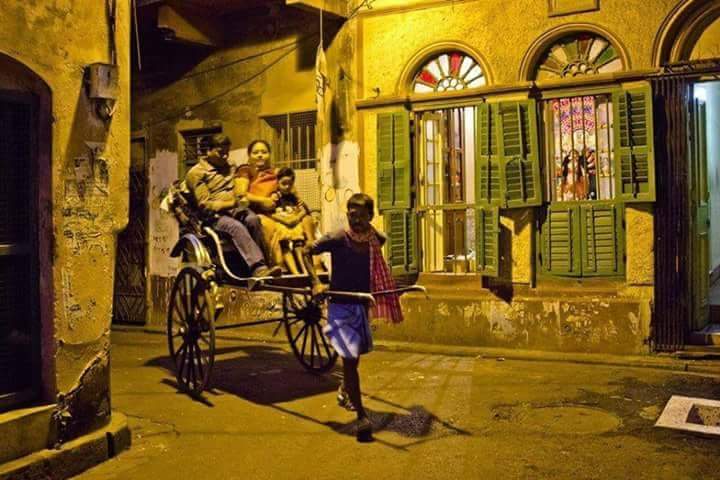
The flavour of Kolkata

The flavour of Kolkata
The city is known for its old alleys. One such is shot by Atanu Pal.
Showing posts with label Exclusive. Show all posts

Tuesday, June 19, 2018

Pratim D Gupta talks 'Ahare Mon'

Last August, he served us a delectable Maacher Jhol. Set in Paris and Kolkata, the film gave us a hitherto unthought of Ritwick as an internationally acclaimed Masterchef in a sensitive mother-son tale. It won both critical and popular acclaim.

This time around, he has trained his focus on pairs of minds of various ages and how they vibe with each other. Simply speaking, an out-of-the-box take on love and companionship, so nicely and aptly named Ahare Mon. It boasts of an eclectic ensemble cast of Anjan Dutt, Mamata Shankar, Ritwik Chakraborty, Parno Mitra, Paoli Dam, Adil Hussain and debutante Chitrangada Chakraborty.

In this short interview, Pratim D Gupta talks on various aspects of his new film in his usual candid manner. Ahare Mon releases on 22nd June 2018.

Pratim D Gupta with Mamata Shankar on the sets of Ahare Mon

Kolkata Curry: If we call Paanch Adhyay vanilla romance, Ahare Mon seems to be a layered, out-of-the-box take on on the subject. Was there a common thread in conceiving all the four stories? How did the stories fall in place?

Pratim: I had two of the stories with me for a very long time. The airport immigration officer story which I had first thought of at least 12-13 years back. And the story of the two thieves too was something I have wanted to see on screen for at least a decade. There are two friends of mine in Mumbai - Harneet and Kartik - and I would discuss with them the Michael Tendulkar-Suzie Q love story. But at that stage both were one line premises. The two other stories emerged last year when I thought of clubbing these short stories together into one feature film. The common thread is love, of course, but it's also about loneliness and companionship and the eternal wait for love.

KC: Given an opportunity in the past, you had a wish to shoot Adil's story with Mithun. They have different appeals and screen presence. What made you select Adil apart from the fact that he is a gifted actor and you admire his work? Did you have to rewrite the track for him?

Pratim: When I thought of that story, I had Mithunda's face in mind. That was a dozen years back. When I finally sat down last year to write out the screenplay, I knew Mithun da would most likely not be available to play the role of Purnendu Pahari. So I didn't have any actor in mind when I finally scripted that story. I tried a couple of actors from the Bengali film industry first and waited for each of them for weeks to confirm their dates. But they just couldn't shuffle their calendar, despite their best efforts. Adil was like an SOS call although he wasn't aware how panicked we all were. Within a day of me sending him the script, he got back saying, "I've just read a couple of pages and I want to do this".

KC: I love both the songs- Monta Ahare and Ahare Mon. Written, composed and sung beautifully, they are urbane and very contemporary in sound. But why did you limit the songs to just two in a romantic tale?

Pratim: It's more of a drama. Not romance in the sense of a Yash Chopra or Karan Johar film. The truth remains that songs hold up the screenplay. So, although I love music and participate heavily in the creation of songs and background scores of my films, I try to keep songs to the minimum.

KC: The Anjan-Mamata pair is coming back  after Jani Dyakha Hawbe (2011). Did you cast them keeping in mind, among other things, their recent and past on-screen chemistry (in Kharij and Grihajuddha)?

Pratim: Can I tell you the truth? I haven't seen Kharij. And I couldn't complete Jani Dyakha Hawbe. Sorry, Birsa! Grihajuddha I have seen but to be honest, no film or moment from earlier films played any role in scripting the Barun Babu - Charulata Debi portion or while directing Anjan Dutt and Mamata Shankar in Ahare Mon. This is a whole new pitch and believe me they have simply knocked it out of the park. Their hotel scene will remain special.


#AhareMon  #BanglaCinema  #BanglaCinema2018  #Cinema


If you liked reading the post, you may visit this blog's Facebook page (click on the link) and hit the 'Like' button to stay connected with the future updates on this blog and more on the page.

Wednesday, June 13, 2018

A freewheeling chat with Srijit Mukherji

He has studied Economics in Presidency College and Jawaharlal Nehru University. He has several years of directorial experience in Bangla cinema behind him. He takes an academic interest in tracking box office figures of his films as well as his peers' and deeply analysing audience response to his films. He has complete knowledge of the work of promising new directors and the response to their films. His contemporaries Shiboprosad Mukherjee and Raj Chakraborty have film production houses to their credit for quite some time. He has worked in Hindi cinema where most of the noted directors have their production house. I had often wondered why he was not starting his production house and taking his creative and economic acumen to the next level.

It was heartening to note a few months back that Srijit Mukherji finally started his production house, thoughtfully named Match Cut Productions, and announced its first production Chowringhee which is a co-production with SVF.

Srijit opens up on his newborn in this Kolkata Curry exclusive interview for the first time (considering all media).

Kolkata Curry: You don't need to look for producers for making your kind of films. It could be similar for web series. What was the thought behind setting up Match Cut Productions?

Srijit Mukherji: There are lots of stories which appeal to me or are close to my heart which already have a storyteller in place. So to be a part of these stories, to facilitate the storytelling process and to bring them to the world, Match Cut was formed. Also, since making films in Bengal taught me a lot of things even outside direction, like production, scheduling, budgeting and marketing, thought Match Cut could be a way to put them to use. The economist in me, I guess, was at play!


KC: What does Match Cut Productions aspire to bring to the table for the industry?

Srijit: New stories, new faces, new voices, unmade projects by known voices, indies which appeal to me, new technicians.

KC: What are your thoughts and plans of working with new directors under your banner? Or handholding independent directors whose films/ content you find promising? You are seen appreciating young talents like Manas Mukul Pal, Indrashis Acharya and Soukarya Ghosal. You presented Pradipta Bhattacharya's national award- winning Bakita Byaktigawto back in 2013. Do you plan to collaborate with some of these names under Match Cut?

Srijit: Absolutely! Much before Rainbow Jelly, I singlehandedly rallied behind the prodigiously talented Shoukarya's Pendulum which blew me away. Even when Manas' Shawhoj Pather Goppo was taken down after an initial run, I protested on social media and used whatever leverage I have, along with Shiboprasad, Shrikant Mohta and Pankaj Ladia to get it back to the halls. I am already collaborating with Paavel on a project, another fantastic talent whose Babar Naam Gandhiji I offered to present. Then there are brilliant new voices like Indrashish Acharya and Sayantan Ghoshal with whom talks are on about possible collaborations. Have been in dialogue with screenwriters like Padmanabha Dasgupta, Debapratim Dasgupta, Dipangshu Acharya and Saurav Palodhi. Match Cut will look at actively producing or promoting content written, directed or both, by these names above, because I firmly believe they hold the key to making the content heavy Bengal film industry even richer.

KC: So far I'm aware, except the Kakababu series and Shibar Phire Asha, which you chose not to pursue after a point of time, you are not known to have expressed interest in adapting Bengali fiction for films. Why did you zero in on Chowringhee as your first co-production while it has had an acclaimed adaptation in Bengali cinema?

Srijit: Before Kabir Suman's Tomake Chai came and changed everything about life from taking pride in one's mother tongue to grumbling, criticizing, condemning but unconditionally loving one's own city, Chowringhee was that novel which did all of that and more to me, at a tender age. In fact one of the earliest memories of a book cover for me is the iconic stamp laden one which hasn't changed over the years. Or the earliest memory of a book ending was the glow sign of Shahjahan. I have never made a film which hasn't come from inside, from an urge, from a deep love, from some piece of nostalgia. So there, the template or formula or pattern or device is absolutely non-existent for me. Chowringhee technically might be a literary adaptation, but for me, is an unforgettable story, an indelible experience which fashioned my mind in early years. Much like Julius Caesar which found its way to Kidderpore in Zulfiqar or like Aban Thakur's Rajkahini found its voice in Rajkahini/ Begum Jaan.


#MatchCutProductions #SrijitMukherji #BanglaCinema


If you liked reading the post, you may visit this blog's Facebook page (click on the link) and hit the 'Like' button to stay connected with the future updates on this blog and more on the page.


Thursday, May 24, 2018

A tete-a-tete with filmmaker Soukarya Ghosal

Soukarya Ghosal was noticed with his first film Pendulum (Bengali, 2014) which was about a surrealist painter. He made a film for film for television in 2015 (shot like a film as it happens in this Zee Bangla Originals series of films) named Load Shedding which I liked for the most part. As he is ready to release his next feature film Rainbow Jelly (Bengali) on 25th May 2018, he talks to Kolkata Curry neck deep in pre-release work. The most curious bit of Rainbow Jelly is that its protagonist is played by Mahabrata Basu who is a special child.


Kolkata Curry: You Facebook profile says you are an animator. What prompted you to become a filmmaker?

Soukarya: I am not an animator. Actually I learnt the process of animation while doing the post-production of Rainbow Jelly. I was a graphic designer and illustrator working with a leading Bengali daily, doing cartoons and writing a few features and page 3 articles. Later on when I came to filmmaking with Pendulum I chose painting to be the subject. The protagonist is a painter who takes his audience into his painting and the space of the painting becomes the real space when one goes into his painting. So, the influence of art was there from my first film since I came from that background. While doing Rainbow Jelly this influence was also there on Ghnoton’s wall and while writing the script I thought that the imagination of Ghnoton would be his own drawings.

KC: Rainbow Jelly is a food fantasy. That's a fresh concept. What was the germ of the idea? Why did you choose to spin a yarn through different flavours of food?

S: Rainbow Jelly is known as India’s first food fantasy film. The concept of food fantasy is that you weave a fantasy story around the basic structure of food. My film is about the seven tastes of food- Sweet, salty, sour, spicy, astringent, pungent and bitter. What I’ve tried to say is that we change in character based on the tastes (of food we eat), like chocolate triggers happy hormones. But it’s much beyond that. While writing the story I was referring to Ayurveda where I found an interesting concept - Don’t make medicine your food. Make food your medicine. With properly recommended, different kinds of food you can heal up your body and mind. Any ancient philosophy believes in development of both body and mind. Ayurveda traces it with much more details like chemical combinations of food but I didn't want to go into such depth as my film is a fun film with children all around and a mysterious character. I just wanted to tell a story where something is happening...something funny is happening with the structure of taste and the change in characters. We also included seven colours with seven tastes and seven is actually a magical number. If you see the film you’ll find that there are seven days, seven colours, seven tastes and seven notes of music. We have merged a food fantasy with all of that. It's a fresh concept which came to me while I was learning cooking. I love to eat and I love to cook. While cooking I’ve found that with your state of mind the taste of the food actually changes. I’ve also found that if you are happy the taste of food is different from the food you prepare when you are not happy. So from there the germ of the idea came and I thought that what if the world can be changed with food.


KC: Tell us how you found your protagonist Ghnoton in Mahabrata Basu who is a special child. What were your ways of getting him follow your instructions on the set?

S: I found Mahabrata with the reference of Moushumidi (Moushumi Bhowmik) who has sung a song in my film. She had come to know that I was looking for Ghnoton. She goes to a school of 14-15 students and teaches English there. I had briefed her on Ghnoton and she said that she knew someone there who she found close to Ghnoton. So she asked the boy to come to my house. Mahabrata came with his father. Initially I didn't think he fit in because he had numb expressions like all special children. But after four-five minutes when he smiled, it was so radiant that I was convinced that he was my Ghnoton. I immediately locked him. After selecting Mahabrata, his mother Gargi-di called me and asked how much of dialogue there was in my script for him. I said that there was just one scene without him and the film had quite an amount of dialogue. She told me to kindly leave Mahabrata therefore because till then in his school there was no concept of memorizing or writing exams. The concept was something alien to him. But I said that I wanted him. While I write a script I do sketches of characters, in black & white and colour. I told her that the features (of Ghnoton) were very close to Mahabrata. Gargidi then said, “OK, fine, give me a few days.” After three days she sent him to my house and asked me to try out the first few scenes with him. He came to my house, ready with the first five-six scenes. When he was stuck with the dialogue and couldn't recall the lines, I would give him the script, but he couldn't make out anything looking at it. When I asked him, I found out that he actually memorized the script because his mother had constantly narrated it to him like Ramayana or Mahabharata after his return from school and that's how he memorized it like shruti of Veda. It was an interesting finding for me that he mugged up the entire script by listening to it. When he came to the floor he was so ready that  he remembered his own lines and others’ lines too. It didn't happen with the other actors who weren't ‘special’ like him. There were directorial assistants to give them the cue (when they couldn't remember the lines) but with Mahabrata my assistants had little to do. With the dialogue he even remembered every narration like the camera was panning or the camera was in the trolley. So Mahabrata was an exceptional case to deal with. I found my protagonist Ghnoton in his smile initially, but later on his numb expressions were very painful for me to change. Then I devised this ‘Smiley method’. I drew 67 smileys on his script- Happy, sad, angry, worried, amazed, irritated etc. I used to make him practise the smileys fast, changing expressions. (While taking shots) I used call out the smiley names and his reaction would change with the command. Mahabrata was an obedient child on the set and above everything he had a tremendous sense of rigour which is a gifted thing. This rigour helps him do certain things that a normal child can not. Actually he is very conscious of his own state and he is constantly challenging the odds he is facing as he always wants to win. And by that he is constantly overcoming himself and developing himself. That makes him easy to deal with as when he used to be stuck with something, most of the times he came up with more rigour to solve the problem.


#RainbowJelly #BanglaCinema #BengaliCinema #BengaliCinema2018 #TollyDiaries


If you liked reading the post, you may visit this blog's Facebook page (click on the link) and hit the 'Like' button to stay connected with the future updates on this blog and more on the page.

Friday, August 04, 2017

A chat with Pratim D Gupta

If Dev D is his Masterchef on camera, he is playing the Masterchef behind it, giving all he can to cook the perfect Maacher Jhol to please his audience later this month. Paanch Adhyay (2016)- the first outing of this long time film journalist, well known for his reviews on t2, didn't cut much ice with the audience, but his second serve Shaheb Bibi Golaam- an edgy thriller set in Kolkata- filled the theatres for weeks last year and won several Filmfare awards too. It was also a musical hit. In the thick of the post-production for Maacher Jhol nowPratim took out some time to have a chat for Kolkata Curry.

Anirban: You were known as a film journalist and film critic till 'Paanch Adhyay' happened. What got you interested in filmmaking and screenwriting which means moving to the other side of the fence?

Pratim: I always wanted to write and direct films. I used to be involved with theatre from my school days. Later I was an active member of the theatre group Komal Gandhar. I did bit roles and a lot of production work. I was also a very good student and got a very good rank in WBJEE but I chose not to become a doctor or engineer because I was always artistically inclined and didn't want to join the herd. (Maacher Jhol also deals with this.) I studied films and English and got a job in a newspaper but I always wanted to make movies. Thanks to my day job, I spent a lot of time on film sets and also watched tons and tons of movies. And then I wrote a script called Vanish which got selected in the NFDC Screenwriter's Lab. That was the start of the journey.

A: Coming to 'Maacher Jhol', it's food film as the name suggests. And that's a brand new genre. Now, Bengalis are known for their devotion for food but I don't think it has ever been really explored in our cinema. What prompted you to make a food film? Also, for those who know you, you are a big foodie. How much of your philosophy of food is there in the film?

P: It's an out-and-out food film where food is a character. I have always wanted to make one. And when we are dealing with food and us Bengalis, I was always sure it would create a new motion picture experience. Because food for us is so much more than just food... memories, culture, state of mind... Of course, there is a very interesting yarn also spun around food. But it is the food factor which makes the film unique. And I've gone really deep into food. Not just Bengali films, I think Maacher Jhol is one of a kind when it comes to food films.

Pratim D Gupta on the sets of Maacher Jhol

A: A big surprise for the audience possibly is casting Ritwick as a Masterchef based in Paris. We know of his powerful acting acumen and you've briefly spoken in the media about how he has been stereotyped in Tollygunge. But what exactly made you think him in the shoes of Dev D?

P: After Shaheb Bibi Golaam I wanted to do a full film with him because I found him phenomenal in a film with such powerhouse actors. He created a performance texture which no one could come close to. And at the same time I was thinking of doing a food film. So the two came together. I never thought a second time about whether Ritwick will be able to pull off a sophisticated character. He can do anything. And to make him look the part, I was confident I could do it. Not just Tollygunge, even Bollywood cannot think beyond certain stereotypes for certain actors. Nawaz plays the same character in every other film. That makes my job all the more challenging and I love that. No one saw Anjan Dutt like a Jimmy Luke, no one saw Swastika in a twinplay like Jaya and Shuktara and no one saw Ritwick as a Masterchef Dev D.

Ritwick Chakraborty in a still from the film

A: We, the audience, miss a screen persona like Mamata Shankar these days. Characters with the kind of sensibility she exuded on screen aren't written anymore. What made you think of her in that role?

P: She is of a different league altogether. I am really honoured that she is the Maa of Maacher Jhol. The scenes with her and Ritwick are so special, that they really hold the film together. I am actually glad that she is extremely picky about her roles and doesn't do whatever is offered to her. We feel so sad to see Soumitra Chatterjee and Madhabi Mukherjee be part of such shoddy films.

A: What's your take on using music in your cinema?

P: Shot taking and using of music are how you can really make out the craft of a director. And I take a lot of active interest in these two departments. Right background music can really uplift a scene to an unforgettable moment. That both my DoP and background music director in Shaheb Bibi Golaam were applauded from all quarters make me very happy. I've got two new partners in Maacher Jhol. Subhankar Bhar has done some incredible work with the frames and Avijit Kundu making his debut as the background music director is my surprise weapon.

A: Lastly, what has the success of 'Shaheb Bibi Golaam' taught you?

P: That my ideas and treatment are audience friendly. That Bengali cinema doesn't need to be restricted to bouts of pseudo intellectualism and unnecessary chatter. That visuals can draw young audiences. That nothing, repeat nothing, is more important than good performances in a film.


Here's wishing the audience savours the steaming hot Maacher Jhol on 18th August.


#TollyDiaries #MaacherJhol #BanglaCinema #Cinema


If you liked reading the post, you may visit this blog's Facebook page (click on the link) and hit the 'Like' button to stay connected with the future updates on this blog and more on the page.

Friday, February 17, 2017

A tete-a-tete with Soumya Shankar Ghosal

An ardent lover of Kolkata like this blogger, Soumya Shankar Ghosal, a management consultant by profession and a photographer by passion, recently made our city proud when he secured the third position in ‘The 20 Most Influential Street Photographers for 2017’ list from across the world derived from a poll on the street photography website www.streethunters.net. His group Streets of Calcutta is perhaps one of the world’s largest street photography archives dedicated to one city. It was nice to engage with him in a conversation which is as follows. The photos in between are handpicked by the ace lensman from his vast body of work.


1. What does this achievement mean to you? How important is this listing?

Achievement is recognition of your efforts. However, saying so, I must reiterate the fact that achievement is not the ultimate goal. Photography is solely pursued for oneself. The next stage is sharing the joy with others. The third stage is the part of recognition. I am a self-taught photographer and didn’t have the privilege of having a master. Hence, recognition in terms of apperception is an acid test that the photograph has passed exam of sharing the joy with the viewer.

The recent listing is sincerely prestigious one. More so because the list features some of the most gifted photographers I look up to and sharing a little space with them is wonderful. I thank each and every one who felt I should be a part of the top 20 out of the 124 photographers nominated from across the world.


2. Going back to where it began. What got you hooked to street photography and when?

I photographed everything that caught my attention but slowly realized that I had developed an inclination towards Street Photography from around 2008. The street is full of surprises. Exploring the same lane at different times will offer different subjects and perspectives. Exploring streets and knowing the unknown Calcutta is always a fun learning experience.

Oh Calcutta! This is what strikes me each time I explore the city. Although, I was born and have lived in this wonderful metropolis for 36 years, I rediscover the city each time I go out on photowalks. I am never bored walking the same alleys over and over again. Calcutta is a city of diversity. Documenting the diversity helps me learn about the city better.


3. Tell us about Streets of Calcutta. How has the experience been so far?

Streets of Calcutta was born out of a passion to create a shared learning platform for a city-based street photography archive. The objective was to enthuse newcomers who love street photography. What started with a single individual has spread to over 20,000 across social media platforms. We don’t consider SOC as a group. Technically, you don’t need to either join or leave. As long as you love photographing Kolkata, we consider you a part of it.


The forum is quit active in terms of the number of posts on the group as well as Instagram. Apart from the offline interactions have done an online review session which had received more than 225 photos in just 1 hour.


The journey has been pretty exciting! Whatever Streets of Calcutta has achieved is because everyone took an ownership of the subject. Friends Indrajit Lahiri, Nilanjan Pathak and Ayanava Sil deserve a special mention. A special ‘Thank you’ to the brilliant photographers who have encouraged us – Mr. Debarshi Duttagupta, Ms. Lopamudra Talukdar, Mr. Bikas Das and Mr. Asis Sanyal.


4. What do you consider a significant achievement of Streets of Calcutta?

The most significant achievement is Streets of Calcutta has been able to bind together like-minded individuals to educate others about street photography. This genre is not documented much. So when the newcomers, the experienced, the good, the better and the best come together, a vast repository of knowledge is created. We believe in the power of shared learning. I am proud to say, Streets of Calcutta has been able to show street photography in a different light in its 2 years of existence.


5. You do photowalks in the city under Streets of Calcutta. What has been your most memorable photowalk experience?

Every walk is memorable. And yet, there is one walk I particularly remember since it was not about numbers but that of sheer passion for photography of my fellow enthusiasts. That was February 2015 and the walk coincided with an India-Pakistan match. And yet 41 participants turned up.

SOC conducted one of its largest photowalks in August 2015 in association with Amazon India at Shovabazar to celebrate World Photography Day. The participation was recorded at 176. Planning was vital and had to be meticulously executed to manage the big turnout efficiently. Team leads were appointed and briefed in advance and group sizes were kept at a suitable number based in the experience of the team leads. The whole program was managed efficiently with the constant support of the leads and the participants.


6. What are the plans of Streets of Calcutta this year?

We have planned a lot for everyone at SOC in 2017. The execution of the same is being worked upon. Mostly this is related to increasing the offline interactive sessions. Last year we had showcased the work of more than 60 individuals at our exhibition ‘Soul of Kolkata’ in association with ITC Sonar and Nikon. This year too we plan to go ahead with its version 2.0 but with a twist.

To check the Street Hunters list ‘‘The 20 Most Influential Street Photographers for 2017’, click here

If you wish to visit Streets of Calcutta, click here
Instagram handle of Streets of Calcutta: streetsofcalcutta
To know Soumya Shankar Ghosal better, visit his website here. 


#interview #streetphotography #StreetsOfCalcutta


If you liked reading the post, you may visit this blog's Facebook page (click on the link) and hit the 'Like' button to stay connected with the future updates on this blog and more on the page.

Friday, December 23, 2016

The Christmas treats from The Lalit Great Eastern Kolkata

The goodiebox from the cake shop of The Lalit Great Eastern Kolkata that arrived in my office was red, so was the man – dressed in a red t-shirt and cap. It felt for a moment that Santa had taken a disguise and appeared ahead of schedule.

The name ‘Great Eastern Hotel cake shop’ takes me back to my childhood. My father’s office was across the road, opposite the hotel’s erstwhile entrance on Old Court House Street. The aroma wafting out of the 19th century bakery (founded by English baker David Wilson) of The Great Eastern Hotel (The previous name) was irresistible and he was among many to queue up at the cake shop for their tempting Christmas cakes. Those wonderful cakes make one of the sweetest memories from that age of mine.

Coming back to the goodiebox. It had a card with handwritten Christmas wish from the General Manager of the hotel. I found a one pound Christmas fruit cake, a pack of Christmas cookies, a vanilla muffin, an orange muffin and a loaf of Masala Bread inside.

 Inside of the Christmas goodiebox

The vanilla muffin tasted good. It had a mild vanilla flavour, had nuts and was not intensely sweet which is how I like my cakes.

The Masala Bread topped with cumin seeds had a mild spicy flavour which was nice. To enjoy a slice of it better, toast it lightly and give it a pat of butter.

 The Masala Bread


The Christmas cake was also delicately sweet and good in taste. The taste is distinctly different from other cakes as they use clarified butter instead of butter. It is not loaded with dry fruits and candied orange peel, so you can have it any time of the year as a tea cake.

 The Christmas cake
 

I liked the Christmas cookies a lot. I crave for good cookies and the hard, crunchy, sticky, coconutty cookies were delicious. They had dried plums for the added goodness and again, were not intensely sweet. The children should love it.

 The Christmas cookies

If you wish to buy your Christmas cake from the hotel's cake shop, it's on Waterloo Street. They've opened well-decorated extended counters outside to cater to the long queue, so once you reach near the hotel at the end of the street, you shall not need further direction. The counters are opening around 9 o' clock. They also have an outlet of the cake shop in New Market where you may visit if you want to avoid a long queue. But try not to go there late afternoon as you may end up being too early for the next day.

My heartiest thanks to The Lalit Great Eastern Kolkata for the gesture! Wish it a great Christmas season!

Wish you a Merry Christmas too! Soak in the chilly weather with good food.


#Christmas #Christmascake #TheLalitGreatEastern #TheBakery #TheLalitKolkata #TheLalitexperience #Heritage #KolkataHeritage


If you liked reading the post, you may visit this blog's Facebook page (click on the link) and hit the 'Like' button to stay connected with the future updates on this blog and more on the page.

Sunday, May 22, 2016

The reopening of a lost hope

It is common knowledge now that it has become a routine for single-screen theatres in Kolkata and other parts of West Bengal to shut down. The state used to have seven hundred theatres (multiplexes apart), a number which is now bleeding at just two hundred and forty eight. Consistent poor business on one hand and rising costs on the other are the primary reasons for their fate. All of us have fond memories of a number of theatres where we used to go to watch movies, which are closed down now.

The just-released Cinemawala by Kaushik Ganguly deals with this brute truth at its core. It’s a father-son relationship story in the backdrop of a closed down theatre in the suburbs.

The lack of business emerges out of basically two reasons- 1. The pathetic box office of Bangla cinema these days (I’m talking of the mainstream releases here, not so-called urban cinema which releases not even in one third of the theatres) and the owners’ apathy to the business. Any business calls for the businessman’s interest and involvement to survive and flourish and there is no reason why a movie theatre would be any different. The state government supported the cause of the theatre owners some years ago by bringing down the amusement tax to just 2% for Bengali movies on condition that the savings would be ploughed back into the improvement and upgrade of the theatres, but most of the theatre owners have been reluctant to avail this opportunity.

On the other hand, changing with the times in terms of technology and amenities and learning smart ways of doing business have kept many theatres in good business not only in Kolkata but in the districts as well. From personal experience in the movie exhibition business (running a movie theatre in other words) spanning Kolkata to interiors of Bengal I know that the audience across economic classes doesn’t mind paying a little more for a better movie watching experience.

At this juncture, it’s incredible to see a closed theatre re-opening. But that’s what has happened almost silently in one corner of Kolkata earlier this month. Ellora, an old theatre in Behala and once a much-loved destination for cine goers, has been re-opened after being closed for three years. This is thanks to the owners of Ajanta Cinema, one of the popular theatres of the city located in the same area.

Tthe owners of Ajanta- the young Satadeep Saha and his father Ratan Saha are passionate about the business of film exhibition and that is the reason why some single screen theatres in Kolkata have moved with time and are sustaining themselves well in the age of multiplexes (Priya being a prime example). Since I was overjoyed with the news, I asked Satadeep how it happened. He shared the inspiring story of their growing cinema business.

They have always wanted to grow screens with good infrastructure. It all started in 2007 when they renovated Ajanta and opened the screen 1 in 2007, followed by its success the screen 2 came in 2008. The next stop was Tripura which has a sizable Bengali population. There was not a single decent theatre in the state. So the Sahas took a calculative risk and opened a four-screen multiplex named SSR Rupasi in 2012. It is running successfully screening new Bengali and Hindi releases.

They were looking for properties to start a new theatre in Kolkata and rather than going for a new property which calls for a substantial investment, re-opening a theatre seemed a viable option. Ellora is a well-located theatre just a few kilometers away, which was closed for three years and they zeroed in on it.

Ellora finally threw open its gates on 6th May 2016. I found it out from a nonchalant status update by Satadeep on Facebook. As he shared, it has been opened as it was,  only with a better projection and sound for now. The Sahas plan to renovate it over time with all modern facilities to qualify it as a movie-viewing option besides the plexes. Ticketing machines are being installed and online booking will be open soon. Good for now! Ellora will show mainly Bengali movies and Hindi movies as well.


A friend born and brought up in Behala informed that decades back Ellora used to be the number one movie destination for the educated middle and upper middle class in Behala. He fondly recalled his family trips to the place in his early school days.

Here’s hoping Ellora earns its lost glory back.


#MovieTheatresKolkata #Ellora #BehalaTheatres #BengaliCinema


If you liked reading the post, you may visit this blog's Facebook page (click on the link) and hit the 'Like' button to stay connected with the future updates on this blog and more on the page.

Monday, March 07, 2016

The Spring-Summer Collection 2016 from Turtle

February saw the release of the Spring Summer collection from Turtle, one of the prominent men’s fashion brands in India. After its 2015 theme ‘Slow up’ (That is looking back at life in our fast-paced lifestyle), the brand takes a product-focused route this season to highlight its key ranges.

Here’s Kolkata Curry taking you through the lookbook of the collection which is based on what’s trending now. The highlights set by the brand’s design studio are bright colours, cool tones, playful, street-friendly patterns and bold textures balancing out subtle shades.

Playful with print

The range that came out in February was ‘Prints’. Printed shirts are eternally in casual fashion and the brand foresees it trending this season. It’s a great companion for a casual evening with friends or a summer invitation to someone’s place. Turtle has laid out its offering in subtle to exotic patterns on cotton, linen and Khadi in all-over and hybrid styles. In regular and chic band collar.


Unwinding after work in a twilight blue printed shirt hung loosely over rolled up black trousers. Sounds cool?


Now consider this dandy look with a printed black satin shirt in Ombre. Complete it with form-fitting black trousers and oxfords.


Wish to stand out amid your conventionally fashionable or boringly dressed peers and friends? Think printed tees. Pair it with the right bottoms/ trousers and carry it with confidence. For example, this all-over bird print tee, worn with cotton stretch joggers and hiking boots.


Turtle has prints in formal shirts too. Consider this pristine white base subtle print. If you are bored with plains and stripes at work, this comes to your style rescue.


March sees the indigo/denim range hitting the shelves. The brand offers a fashionable shirt collection of washed, engineered and naturally died textures in stripes, prints and plains.


The denim trousers range has wasted, distressed, structured and engineered styles in iconic washes and shades. Since the jeans range in Turtle has never really made a noise, I’m looking forward to this collection.


Play around with Khaki
The fashion forecast for the season has khaki as the runway favourite. Come April and Turtle plans to load the shelves with not three or four but seven handpicked shades of khaki- in stone, ochre, grey, white, sand and earthy to let you be boho chic. Work or off work, khaki can be your regular companion.


Think summer and linen comes to mind. As expected, the brand has laid out its linen range of shirts & trousers with cool, colourful and comfort shades which will be available in May.

This shirt in a pastel shade of pink is a classic linen pick and makes you effortlessly fashionable in the day.


Who says layering is not for summer? Consider this summery layered look: A powder blue printed linen gilet worn over a band-collared beige Khadi shirt paired with light grey linen trousers with a summer scarf wrapped around. Carried well, it can take your style quotient several notches up.                


Stand out with Khadi

I consider one of Turtle’s USPs to be the Khadi collection. It will be the last in the spring summer collection to hit the shelves (in June). Turtle is trying to redefine the low-profile Indian fabric by taking it to the fashion highway. Did you know that when it’s summer at its harshest, especially the humidity hitting the highest numbers, khadi can be your best bet in comfortt? This handspun, rough-textured fabric is known as the ultimate airy and eco-friendly fabric that will bring you the much needed relief in the most demanding summer. To top it you can take pride in wearing a truly Indian fabric. The Turtle khadi collection will sport a long range of stylish colours with natty prints and smart cuts. Give khadi a shot in your style statement this summer and become the trendsetter in your friend and social circles. Post selfies wearing cool Khadi shades in your social media channels.


For a detailed look at the collection, or shopping online, visit the Turtle website . You may also check out its Facebook page or Twitter handle for updates. 


#TurtleTrending #SpringSummerCollection #Prints #Khaki #Khadi


If you liked reading the post, you may visit this blog's Facebook page (click on the link) and hit the 'Like' button to stay connected with the future updates on this blog and more on the page.

Saturday, November 29, 2014

Atanu Ghosh talks ‘Ek Phali Rodh’


I have liked the craft  of Atanu Ghosh right from his telefilm days for his choice of subjects, his ability to develop the characters and storytelling. His debut film Angshumaner Chhobi (where he gave first break to one of my favourite actors Indraneil Sengupta) was critically acclaimed. I liked most of his second film Takhan Teish. But I loved his last outing Rupkatha Noy which was received well by the cinema-loving audience. As the countdown for his December 5 release Ek Phali Rodh is on, the director makes time for an exclusive interview to this blog on his new film. It has an impressive lead cast of Dhritiman Chatterjee, Ritwik Chakraborty, Jisshu Sengupta, Tota Roychoudhury and Aparajita Ghosh Das.
Kolkata Curry (KC): Ek Phali Rodh revolves around the bystander effect. The subject sounds more documentary than a full length feature film. What made you approach and develop such a subject for the big screen? Weren’t you apprehensive of audience acceptance?
Atanu Ghosh (A): On the contrary, I feel there is little you can ‘document’ about Bystander Effect, because it happens in reality and you do not know when it is going to happen ! So you cannot get prepared to photograph it unless you have CCTV cameras fitted in every nook and corner of the city that captures real life. What drew me to the subject was the method adopted by social scientists to study it, that is, the process of creating ‘mock’ crisis. Fiction films are about ‘mock’ situations and ‘crisis’ is the most dominating dramatic interest in any fictional film. So I had no apprehension whatsoever regarding the choice of the subject and I knew for certain that it has all the ingredients that go into making of an engrossing fiction film.

KC: Like your last film Rupkatha Noy, does it also have stories running parellely?

A: No, here a group of people get assembled towards the common cause of exploring the process of Bystander Effect, that is, the socio-psychological phenomenon where people do not offer any help to a stranger in crisis. But, thereafter the film branches out exploring other facets of life. So the Bystander Effect is actually the springboard from where the film originates and then undertakes a journey of self-discovery.

KC: The shooting must have been challenging, considering you did candid shooting on real locations for some outdoor scenes.

A: Since the issue is straight out of our lives and directly related to our own experience, I wanted the film to have the feel of emerging out of ‘real’ life. I avoided all sorts of made-up or decked -up situations, which is normally done in case of fictional films. So it is like ‘photographed reality’. No superficiality. No overplayed emotion. No pretension. We shot in crowded roads using hidden cameras and even when the locations were indoor, we chose places like general ward of public hospital during visiting hours. So, the actors, in a way, mingled with the general crowd to get as close to reality as possible. Yes, it was very difficult at times, but very really challenging as well.

KC:  Like the last one, this also has an ensemble cast. Please share with us how you went about casting the main characters.

A: Never before, I had so many of my favourite actors working together, as in Ek Phaali Rodh. I craved for those who keep us glued to the screen not only for the principal cast but also for the notable cameos. So we have Dhritiman, Ritwik, Jisshu, Tota and Aparajita playing the lead while Rudranil Ghosh, Arunima Ghosh, Dulal Lahiri, Barun Chanda and Arindam Sil have enriched the film with their brief but glowing presence. And keep your eyes open for two young debutants who are bound to steal the show - Mahua Halder and Aritro Dutta.

KC: Do you think Tota is an underrated and underutilised actor ?

A: Undoubtably so. The effort Tota puts into a role is incomparable. His willingness to push his capacity to its limits has given us memorable performances in Chokher Bali and Angshumaner Chhobi and I really believe he would be a revelation in Ek Phaali Rodh as well. He has put in an entirely different body language to bring out the contrasting qualities of strength and vulnerability in the role of the blind author of love stories.

KC: Joy Sarkar has scored the music again for your film. How have you used it in the film ?

A: I always want music to flow out effortlessly from a film. I don’t want them to remain separate entities as song numbers or background pieces. They should integrate into the fabric of the film and become quite invisible. Joy is remarkably spontaneous. He can effortlessly blend a song into the fabric of the film. In Ek Phaali Rodh, the songs provide an alternate layer of input – sometimes they hold a torch to a character’s psyche, sometimes they add a footnote to the images and sometimes they even suggest an alternate interpretation of the scenes.

KC:  Finally, which Bengali films have you liked in 2014, and why?

A: In the last few years, I am really drawn to the wide range of subjects that Bengali films are trying to explore. It’s really fascinating to come across some specimens of unique concept and novel treatment. In 2014 too, I liked quite a few films for various reasons, the last one being Chotushkon for its distinctly different form of storytelling.
Here’s wishing Ek Phali Rodh all the very best.