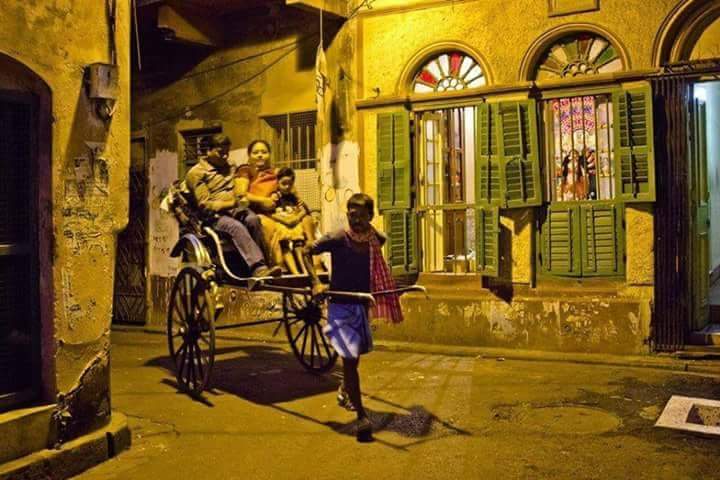
The flavour of Kolkata

The flavour of Kolkata
The city is known for its old alleys. One such is shot by Atanu Pal.
Showing posts with label Travel spots. Show all posts

Monday, August 13, 2018

A police library with a difference

Today being National Librarian’s Day, I wish to talk about a new library that charmed me.

I came to know of it from a Facebook post of Kolkata Police. Known as Kolkata Police Museum on Google Maps, its full name is Kolkata Police Museum, Library and Cafeteria. It’s located at 112 Ripon Street (on the left approaching Wellington).

I visited it with three friends who got interested hearing of it (two of them read the Facebook post too). The museum is small and spread over two floors. Its main attraction is arms seized by police from various periods of history dating back to pre-independence era.


Photograph by Arnab Banerjee

It shows the evolution of the police uniform since the colonial times. The winners of various awards/ honours of police are listed. It states that Natha Singh was the first Indian to win a traffic roll of honour and he won honours in two consecutive years, 1938 and 1939. A section familiarizes with various badges of the ranks of police which is an important civil information.


The history of the house is interesting too. The second prince (Mejokumar) of the erstwhile Bhawal Estate, who is popularly known as 'Sanyasi Raja' (The monk king), thanks to the popular Bengali movie of the same name made on him, fought the famous Bhawal Monk case from this house. It is regarded as one of the most extraordinary cases ever fought in Indian judicial history which took place in 1933-1936. As it happened, a monk came to the estate and claimed himself to be the Mejokumar who was known to have died eleven years back, and demanded his share of the estate.

Available documents show that it was the residence of Calcutta High Court Barrister RS Tweedle in 1874. After changing hands it landed with lawyer SN Matilal (in 1912) whose daughter Sarajubala Devi was married to the first prince of the Bhawal estate. It went to be part of the estate thereafter.

The house was decided to be demolished given its pathetic condition at a point of time. Kolkata Police took it as a challenge to restore it, and I must say they have done an exemplary job! Post the painstaking restoration, it was declared a 'Restored Heritage Building of the City' by INTACH. 

Coming to the library. It took me by surprise by the kinds of books in its collection as it completely beats the perception of a police library. I later realised it was by design, thanks to the Commissioner of Police Mr Rajiv Kumar, as it has been envisioned as a centre for police-citizen connect. The CP is so attached to it that it is said to be his second home and he is often seen there. The surprise element is that it has a wide collection of books for all the members of a family, from the junior to the seniormost. The fiction section is amazingly robust with admirable collection of classic literature, juvenile literature and classic thrillers.  The non-fiction range is pretty good too, including study books in various disciplines like finance and management. There are many Bengali titles too, both in fiction and non-fiction. Noticed the now popular book on fascinating cases of Kolkata Police written by senior police officer Supratim Sarkar, titled Goendapith Lalbazar (The English translation named ‘Murder in the City’ is available too). Before it became a book, the stories were being published in the Rohoshyo Robbar series on Kolkata Police Facebook page and they gradually whipped up a huge following.  

The library has over ten thousand books.

At the end of our tour of the library, what blew my mind was the extensive collection of comic books in English to hook the youngest readers. Imagine a police library keeping a huge collection of Tintin and Asterix, Marvel and DC!!

As Sub-Inspector S Sharma, the friendly gentleman who acquainted us through the library, told us, it is open seven days a week, 11 am to 7 pm. However, the best time is weekend as visitors are much less. They encourage one to come with the whole family and spend a good number of hours there. To help the purpose, there’s a cool cafe, interestingly named Off Duty Delights, which serves (non-alcoholic) beverages and a good range of snacks. We liked the iced tea. For the overall feel, one of the friends compared it to the British Council Library.


Iced tea

The membership fee is Rs 800 per annum plus Rs 100 as a one-time cost of membership card. You can take books or DVD or both and keep upto two books for a maximum of four weeks.


#NationalLibrariansDay #Library #Museum #Heritage #History


If you liked reading the post, you may visit this blog's Facebook page (click on the link) and hit the 'Like' button to stay connected with the future updates on this blog and more on the page.

Wednesday, September 14, 2016

A visit to Botanical Garden

The only time I visited Botanical Garden was in my childhood. It was my father’s office picnic. So, a visit to this place so near Kolkata was long due.

The garden, commonly known as Indian Botanic Garden and formally known as Acharya Jagadish Chandra Bose Indian Botanic Garden, located in Shibpur in the city of Howrah, is one of its kind in India. Spread over 109 hectres, it has a collection of 12,000 specimens of plants and trees from all over India.

After I stepped into this heritage garden with my family last month, it didn’t take me long to connect with nature. Maybe because we entered from the second and relatively new gate, I didn’t spot too many people around. This urban forest offers complete tranquility and the only sound that breaks the silence is chirp of birds. Such a welcome break from the daily grind!

The main gate, adjacent to the bus stand

The second gate

If you like nature, and the stress at work becomes too much to for your nerves, a day trip to this place is what the doctor ordered. Nothing soothes the frayed nerves as much as nature and you shall come back rejuvenated. If you have some creative work to do, a place like this can aid the thinking process by a great deal. You can just be with yourself at the lap of nature with nothing to distract your mind (other than your mobile phone, of course).


I came across various types of trees and creepers as well as blooming flowers and fruits I have never seen in my life.


One of the many species of bamboo tree


The garden was set up by Colonel Robert Kyd in 1787. It was known as ‘Company Bagan’ then (after the name of East India Company). Kyd also served as the Honorary Superintendent of the garden from the beginning till 1793. The primary objective of the garden was identifying new plants of commercial value, such as teak, and growing spices for trade. According to Sir Joseph Dalton Hooker, one of the greatest British botanists and explorers of the 19th century, the introduction of the tea plant from China may be considered one of the greatest accomplishments of this botanic garden. This led to another significant contribution- according to Sir Hooker, the establishment of the tea trade in the Himalaya and Assam is almost entirely the work of the superintendents of the botanic garden of Kolkata and Saharanpur.

The garden has a rare variety of water lily (Scientific name Victoria amazonica). Its leaves are so large and robust that it is said that a leaf can hold an infant.


Came across a palm house but unfortunately it was closed. Here’s a peek from the gate.


There are battery-operated cars of various sizes that can take visitors to a paid guided tour of the garden. They can be booked at the main gate.
  

Despite housing a mammoth collection of plants and trees, including countless rare species, the garden is pretty ill-maintained. Many of the trees are not labelled with name, scientific name and other details and road directions to visitors like which sections are located where are poorly maintained. The roads are kept clean but.


The faulty tap that throws water in all directions

The garden is by the river Hooghly (also known as Ganga or The Ganges).  There is a promenade by the river and sitting there can add to the experience.


The garden is a no-plastic zone. So, don't carry plastic bags. Also, bring your own food if you wish to eat, as, unfortunately, there is no food kiosk/ eatery inside. Even outside the main gate there is a sole low-end restaurant which is the only decent place to have a meal.  


#BotanicalGarden #NaturePark #KolkataTravel #TouristAttraction #StressBuster


If you liked reading the post, you may visit this blog's Facebook page (click on the link) and hit the 'Like' button to stay connected with the future updates on this blog and more on the page.

Sunday, January 04, 2015

A visit to the museum

Relived my childhood through a visit to Indian Museum with my daughter on last Christmas eve. Visited the place only once with my father ages back. Have wanted to go back many a time all this while. The museum turned 200 years last year.
It has extensive collection of exhibits of anthropology, archaeology, geology, botany, zoology and art spread in 25 galleries on three floors. The ticket has a do-it- yourself guide of all the galleries and facilities of the museum at the back which I found very useful. It was a tad disappointing that many galleries were closed for modernization. But it did feel good to see the improved aesthetics and presentation of the modernized galleries- for example terracotta, zoology and Egypt. The ticket costs just Rs 10 and you can do photography of the exhibits on collecting a permit for Rs 50 (and it’ll be worth it) from the counter.
Not much is to be said about the collection. It’s amongst the best in India. A child of any age will be mesmerized by the exhaustiveness of the exhibits in various sections. The visit will be especially enriching if he/ she has been studying Indian history and life science for a few years. My little one was obviously excited to see the dinosaur skeletons and the mummy in the Egypt gallery (which is one of the museum’s major attractions) in particular.
I was amused by two exhibits. One was a 19th century chessboard from Murshidabad in the Decorative Art section on the second floor. It’s a standard size marble board with chessmen made in ivory. The unique feature was that all the chessmen were actual- so there were actual boats, elephants, horses and soldiers. The other one was a life size Durga idol completely made in jute in the ‘Plants in the service of man’ section on the same floor.

The chessboard
The collection is so vast, an entire day (It’s open 10 am to 4.30 pm/ 5 pm) may feel short if almost all the galleries are open. We spent about three hours and had to rush through many sections. There’s a sprawling, well-manicured lawn inside where you can rest your aching feet after/ in the middle of the tour in the mellow sun in this season. Food isn’t allowed inside. There’s an in-house cafeteria, but though the food is decent and reasonably priced, it lacks variety. In the afternoon we found nothing other than kachuri (puri)-ghooghni  (which we had) and rice meals available and the items were getting sold out fast.

The pristine white Raj era building and the lawn