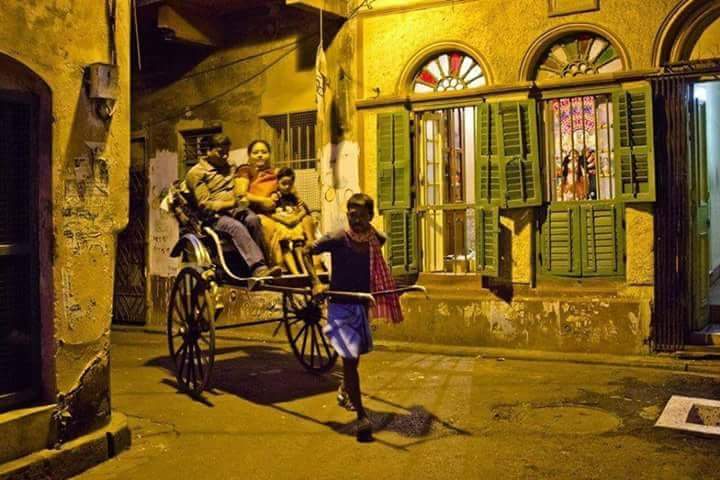
The flavour of Kolkata

The flavour of Kolkata
The city is known for its old alleys. One such is shot by Atanu Pal.
Showing posts with label Cinema. Show all posts

Sunday, March 31, 2019

A take on 'Kia and Cosmos'


Language: English
Director: Sudipto Roy
Cast: Ritwika Pal, Swastika Mukherjee, Joy Sengupta, Sraman Chatterjee, Zahid Hussain, Mita Chatterjee
Length: 2 hours 6 minutes
Release date: 29th March 2019

Kia and Cosmos is a heart-warming story of a specially abled child's (Kia) quest to find out who killed her cat Cosmos who was pregnant and in the bargain, taking a leap in becoming independent. The story is from Kia's point of view, which makes for an interesting watch, and it's brilliantly crafted by director Sudipto Roy. Aditya Varma's cinematography helps create Kia's world with finesse and elevates the film. Ritwika is astonishingly good as she brings Kia to life. Kudos to the immense potential of this young debutante! Swastika is brilliant as Kia's mother- the vulnerable and loving Dia. Joy Sengupta is very good as her musician father Kabir and so are Sraman Chatterjee and Zahid Hussain (Kia's teacher). Neel Adhikari's music and minimal background score take the storytelling forward. I just thought there was a problem with pacing in places and it could be tighter. Overall, a memorable cinematic experience which explains why this film was an official selection in film festivals in Glasgow, Milan, Barcelona and Madrid.


#KiaAndCosmos #SwastikaMukherjee


If you liked reading the post, you may visit this blog's Facebook page (click on the link) and hit the 'Like' button to stay connected with the future updates on this blog and more on the page.

Sunday, March 24, 2019

A take on ‘Mahalaya'

Language: Bengali
Director: Soumik Sen
Cast: Jisshu Sengupta, Subhashis Mukherjee, Prosenjit, Saptarshi Roy, Subhomoy Chatterjee
Length: 1 hour 48 minutes
Release date: 1st February 2019

Mahalaya takes us back to the historical incident etched in Bengali’s cultural history when an iconic radio programme on the day of Mahalaya famous for the chants of Birendra Krishna Bhadra was audaciously replaced by Akashvani with another program with the biggest ever filmstar Uttam Kumar as the star attraction.

Mahalaya had an interesting premise but the execution left a lot to be desired. The first few minutes involving a senior and powerful All India Radio official who catalyses the change of the iconic Mahalaya programme set the tone and texture of the film which rules out finesse. Prosenjit who plays the official Shashi Sinha delivers an exceptionally weak performance thanks to an unconvincing diction of Hindi and over-the-top portrayal full of familiar mannerisms. The same loudness is noticed in a key character Banerjee (Kanchan) and partly in Kolkata station director Stevenson (Jayant Kripalni).

In terms of direction, the narrative ends up as more documentative and less drama as it talks too much through dialogue and shows too less going against a hallmark of good cinema. Apart from some melodramatic bits, what mars the watching experience is unnecessary or careless intrusions of celebrities like Kishore Kumar and Manna Dey and even Rabindranath Tagore who is shown in a scene. I seriously wonder, couldn't the makers find out an artist who
would at least sound like Kishore Kumar?


Thankfully, Subhashish shows his class bringing to life Birendra Krishna Bhadra in a nuanced and understated performance and Jisshu does a somewhat decent job as Uttam Kumar (though more care should have been taken by the director to bring alive the biggest star in Bengali cinema).  Subhomoy Chatterjee as Pankaj Kumar Mullick is a laudable act and Saptarshi Roy as Hemanta Mukherjee is good too. One however wonders if the director has taken a little too much of creative liberty in developing the character of Hemanta making him overconfident and setting a wrong precedence of a guru-shishya relationship (with Pankaj in this context).


#Mahalaya #BanglaCinema #BanglaCinema2019 #BengaliCinema #UttamKumar


If you liked reading the post, you may visit this blog's Facebook page (click on the link) and hit the 'Like' button to stay connected with the future updates on this blog and more on the page.

Saturday, January 05, 2019

Film review: Rosogolla

Language: Bengali
Director: Pavel
Cast: Ujaan Ganguly, Abantika Biswas, Bidipta Chakaraborty, Rajatava Dutta, Kharaj Mukherjee, Aparajita Adhya, Chiranjeet, Shantilal Mukherjee, Kaushik Sen
Length: 2 hours 18 minutes
Release date: 21st December 2018

“Je somoy niye bhabena, taake niye toh bhabtei hoy" ( If someone is oblivious of the time lost (in creation), I better take him seriously).

A confectioner says this in the film in respect of his potential competitor Nobin Chandra Das who is lost in the pursuit of invention of his dream dessert for years. This is what makes Rosogolla more than a sweet love story where the boy fights all odds to invent his girl’s dessert of desire and it simultaneously becomes an inspiring saga of perseverance of a creator. And that makes it a story that very much needed to be told.

Rosogolla is the real life story of the nineteenth century invention of Bengal's globally famed dessert (Rosogolla) by confectioner Nobin Chandra Das who took up the challenge in his early twenties to make a sweet of his lover's desire, nothing like which anyone had ever seen. He married Khirodmoni, his love, through the course of this and fulfilled her desire amid all kinds of misfortune, insult and unending failures that came their way.

Ujaan Ganguly as Nobin Chandra Das

The charm of the film is that it’s a simple story of Bengali’s favourite dessert that’s simply told. The story is penned well by Pavel and Smaranjit Chakaraborty, a well-known author. Pavel spins his yarn on screen with a main thread in a pleasingly unhurried pace and does not digress with sub-plots and unnecessary characters which is not unusual in a period piece. Though the storytelling approach is modelled on mainstream and lacks nuances in places and in some characters, it is thoroughly watchable. It is adorably garnished with dollops of old world charm of the nineteenth century Kolkata. The trivia of invention of Aam Sandesh and Baikuntho Bhog is also one of the attractions.

Having said that, the chemistry between Nobin and Khirodmoni needed better crafting. Many moments between them could be developed better. Also, the character of Baikuntho (Nobin’s partner) is over-the-top and Amritalal Banik (The patents man) is not well-etched.

Abantika delivers a fine and convincing portrayal of Khirodmoni in her debut. She brings out well the chirpy, tomboyish, yet level-headed girl who is the perfect foil to the unmaterialistic genius Nobin Chandra Das and his strongest pillar of support. Ujaan as Nobin shows promise in some scenes with measured delivery but surprisingly goes over the top in quite a few scenes. The story being centred on his character, the performance called for thoughtful handling and the director shares responsibility for this too. Rajatava as Kalidas Indra (The confectioner who was Nobin’s first employer and subsequent competitor), Kharaj as Mahesh, Nobin’s assistant, Aparajita as the golden-hearted zamindar wife and Bidipta as Nobin’s mother are well cast and play their parts well. Lew Hilt is a pleasant surprise as Paolo, the British gentleman who was a patron of the native culture. It has the historical character of confectioner Bhim Chandra Nag (played well by Tamal Roy Chowdhury) and another confectioner Ganguram also appears in a flash. However, Kaushik Sen doesn’t shine as Amritlal Banik with a stylization that doesn’t quite fall in place and Shantilal, with an awful wig, isn’t impressive as Chandu Babu/ Baikuntho except for the end appearance. Subhashree’s Hindi in the character of Malkhaan jaan, the tawaif  needed more attention.

Abantika Biswas as Khirodmoni

Music is a strength of the film and the earthy score of Kalikaprasad aid the storytelling brilliantly. Khodar Banda breaks out amid virgin rural landscape within a few minutes of the film, giving it a zesty start. Tapur Tupur, brilliantly written, composed and sung by Arnab Dutta is an immensely endearing love ballad. Supriyo Dutta’s camerawork brings out the era nicely. It was obvious that the production design had a woefully limited budget for a period piece and despite best efforts, outdoor shots of Kolkata stuck out unflatteringly which computer graphics couldn’t make good. Though it is not desirable in a period film, I would still like to overlook this blemish as it is a satisfying watch on overall consideration.

At the end, it suffices to say that every Bengali across the world should watch this film as it’s a story of our roots that is worthy of it.


#Rosogolla #BanglaCinema #NobinChandraDas


If you liked reading the post, you may visit this blog's Facebook page (click on the link) and hit the 'Like' button to stay connected with the future updates on this blog and more on the page.

Tuesday, December 18, 2018

2019: A year of thrillers in Bangla cinema

One genre that never goes out of favour with Bengali audience is thriller. And standing now, 2019 looks like a bonanza for the audience with a possible release of five thrillers made by two big names, one young and successful director and two promising filmmakers. Here you go.

Ink
A long cherished script of Pratim D Gupta who treated the audience with a delectable Maacher Jhol in 2017. The script of Ink was selected in the coveted Sundance Screenwriters Lab in 2014. Starring Pratim’s favourites Ritwick and Paoli, it’s about a superstar and a reporter with a mundane job (played by Paoli and Ritwick respectively) and the strange relationship between them. Director-actor Gautam Ghose is playing the editor of the newspaper where Ritwick works and it also has the talented Chitrangada Chakaraborty (who played a cancer patient obsessed by a superstar in Pratim's Ahare Mon). Pratim shot major parts of the film even before his unusual love story Ahare Mon released last year. The credentials of the script will be a major reason for me to look forward to Ink.

Vinci Da
Srijit Mukherji has recently finished shooting his new thriller centred around a make-up artist and a serial killer and looks set for a Nawbobawrsho date (April). The director is back to the genre which brought him fame and recognition with two films. Baishe Srabon, his second film starring Prosenjit and Parambrata, catapulted him to the big league and Chotushkone, which had some experimental treatment and an ensemble of Aparna Sen, Chiranjeet, Parambrata and Gautam Ghose, gave him two national awards, a first for him, besides box office success. Vinci Da boasts of a powerful cast- Rudraneel Ghosh and Ritwick Chakaraborty in the lead, Sohini Sarkar and Anirban Bhattacharya playing a cop.

Rawkto Rahoshyo
After making Pendulum and this year's critically acclaimed food fantasy Rainbow Jelly, Soukarya Ghosal just finished shooting his next, reported to be a medical thriller, in one demanding schedule. Starring Koel, Chandan Roy Sanyal, Rwitobroto Mukherjee and Basabdatta Chatterjee (of Asha Jaoar Majhe by Aditya Bikram Sengupta), it has Koel playing a headstrong and brutally honest RJ.

Khela Jokhon
The name and cast of this dark thriller by Arindam Sil, whose expertise in the genre is well established, was announced last week. It's about the journey of a woman who comes out of the coma and gradually turns violent because of situations contradicting her beliefs. As the director said, film will start on a calm note and gradually turn violent. The eclectic cast has Sayani Gupta (You saw this Bengali actress from Kolkata in Fan), Abir, Adil Hussain, Jayant Kripalni, Indrashish Roy and June Maliah among others. Interestingly, Arijit Biswas, the co-writer of one of this year’s most acclaimed films Andhadhun (a thriller with a dark comedy streak), Badlapur and Agent Vinod, is writing the script in collaboration with the director. To be shot in Odisha, which is less explored in Bangla cinema, and Kurseong, it goes on floors coming February.

Parcel
Finally, Indrashis Acharya, noticed for his debut directorial Bilu Rakkhosh  in 2017 and Pupa this year, both liked by discerning audience, has turned his attention to this thriller starring Rituparna which seems to be about facing the dark past of a character. Indrashis is known for his treatment of the intricacies of the human mind. So the film, a new genre for the talented new director, will be worth looking forward to.


#Thriller #BengaliCinema #BengaliCinema2019 #VinciDa #SrijitMukherji #ArindamSil #SundanceLab


If you want to keep tabs on Bangla cinema, you may join my Facebook group We the Audience, known for quality content, audience reviews and discussions of Bangla and Hindi cinema, here.


If you liked reading the post, you may visit this blog's Facebook page (click on the link) and hit the 'Like' button to stay connected with the future updates on this blog and more on the page.

Tuesday, June 19, 2018

Pratim D Gupta talks 'Ahare Mon'

Last August, he served us a delectable Maacher Jhol. Set in Paris and Kolkata, the film gave us a hitherto unthought of Ritwick as an internationally acclaimed Masterchef in a sensitive mother-son tale. It won both critical and popular acclaim.

This time around, he has trained his focus on pairs of minds of various ages and how they vibe with each other. Simply speaking, an out-of-the-box take on love and companionship, so nicely and aptly named Ahare Mon. It boasts of an eclectic ensemble cast of Anjan Dutt, Mamata Shankar, Ritwik Chakraborty, Parno Mitra, Paoli Dam, Adil Hussain and debutante Chitrangada Chakraborty.

In this short interview, Pratim D Gupta talks on various aspects of his new film in his usual candid manner. Ahare Mon releases on 22nd June 2018.

Pratim D Gupta with Mamata Shankar on the sets of Ahare Mon

Kolkata Curry: If we call Paanch Adhyay vanilla romance, Ahare Mon seems to be a layered, out-of-the-box take on on the subject. Was there a common thread in conceiving all the four stories? How did the stories fall in place?

Pratim: I had two of the stories with me for a very long time. The airport immigration officer story which I had first thought of at least 12-13 years back. And the story of the two thieves too was something I have wanted to see on screen for at least a decade. There are two friends of mine in Mumbai - Harneet and Kartik - and I would discuss with them the Michael Tendulkar-Suzie Q love story. But at that stage both were one line premises. The two other stories emerged last year when I thought of clubbing these short stories together into one feature film. The common thread is love, of course, but it's also about loneliness and companionship and the eternal wait for love.

KC: Given an opportunity in the past, you had a wish to shoot Adil's story with Mithun. They have different appeals and screen presence. What made you select Adil apart from the fact that he is a gifted actor and you admire his work? Did you have to rewrite the track for him?

Pratim: When I thought of that story, I had Mithunda's face in mind. That was a dozen years back. When I finally sat down last year to write out the screenplay, I knew Mithun da would most likely not be available to play the role of Purnendu Pahari. So I didn't have any actor in mind when I finally scripted that story. I tried a couple of actors from the Bengali film industry first and waited for each of them for weeks to confirm their dates. But they just couldn't shuffle their calendar, despite their best efforts. Adil was like an SOS call although he wasn't aware how panicked we all were. Within a day of me sending him the script, he got back saying, "I've just read a couple of pages and I want to do this".

KC: I love both the songs- Monta Ahare and Ahare Mon. Written, composed and sung beautifully, they are urbane and very contemporary in sound. But why did you limit the songs to just two in a romantic tale?

Pratim: It's more of a drama. Not romance in the sense of a Yash Chopra or Karan Johar film. The truth remains that songs hold up the screenplay. So, although I love music and participate heavily in the creation of songs and background scores of my films, I try to keep songs to the minimum.

KC: The Anjan-Mamata pair is coming back  after Jani Dyakha Hawbe (2011). Did you cast them keeping in mind, among other things, their recent and past on-screen chemistry (in Kharij and Grihajuddha)?

Pratim: Can I tell you the truth? I haven't seen Kharij. And I couldn't complete Jani Dyakha Hawbe. Sorry, Birsa! Grihajuddha I have seen but to be honest, no film or moment from earlier films played any role in scripting the Barun Babu - Charulata Debi portion or while directing Anjan Dutt and Mamata Shankar in Ahare Mon. This is a whole new pitch and believe me they have simply knocked it out of the park. Their hotel scene will remain special.


#AhareMon  #BanglaCinema  #BanglaCinema2018  #Cinema


If you liked reading the post, you may visit this blog's Facebook page (click on the link) and hit the 'Like' button to stay connected with the future updates on this blog and more on the page.

Wednesday, June 13, 2018

A freewheeling chat with Srijit Mukherji

He has studied Economics in Presidency College and Jawaharlal Nehru University. He has several years of directorial experience in Bangla cinema behind him. He takes an academic interest in tracking box office figures of his films as well as his peers' and deeply analysing audience response to his films. He has complete knowledge of the work of promising new directors and the response to their films. His contemporaries Shiboprosad Mukherjee and Raj Chakraborty have film production houses to their credit for quite some time. He has worked in Hindi cinema where most of the noted directors have their production house. I had often wondered why he was not starting his production house and taking his creative and economic acumen to the next level.

It was heartening to note a few months back that Srijit Mukherji finally started his production house, thoughtfully named Match Cut Productions, and announced its first production Chowringhee which is a co-production with SVF.

Srijit opens up on his newborn in this Kolkata Curry exclusive interview for the first time (considering all media).

Kolkata Curry: You don't need to look for producers for making your kind of films. It could be similar for web series. What was the thought behind setting up Match Cut Productions?

Srijit Mukherji: There are lots of stories which appeal to me or are close to my heart which already have a storyteller in place. So to be a part of these stories, to facilitate the storytelling process and to bring them to the world, Match Cut was formed. Also, since making films in Bengal taught me a lot of things even outside direction, like production, scheduling, budgeting and marketing, thought Match Cut could be a way to put them to use. The economist in me, I guess, was at play!


KC: What does Match Cut Productions aspire to bring to the table for the industry?

Srijit: New stories, new faces, new voices, unmade projects by known voices, indies which appeal to me, new technicians.

KC: What are your thoughts and plans of working with new directors under your banner? Or handholding independent directors whose films/ content you find promising? You are seen appreciating young talents like Manas Mukul Pal, Indrashis Acharya and Soukarya Ghosal. You presented Pradipta Bhattacharya's national award- winning Bakita Byaktigawto back in 2013. Do you plan to collaborate with some of these names under Match Cut?

Srijit: Absolutely! Much before Rainbow Jelly, I singlehandedly rallied behind the prodigiously talented Shoukarya's Pendulum which blew me away. Even when Manas' Shawhoj Pather Goppo was taken down after an initial run, I protested on social media and used whatever leverage I have, along with Shiboprasad, Shrikant Mohta and Pankaj Ladia to get it back to the halls. I am already collaborating with Paavel on a project, another fantastic talent whose Babar Naam Gandhiji I offered to present. Then there are brilliant new voices like Indrashish Acharya and Sayantan Ghoshal with whom talks are on about possible collaborations. Have been in dialogue with screenwriters like Padmanabha Dasgupta, Debapratim Dasgupta, Dipangshu Acharya and Saurav Palodhi. Match Cut will look at actively producing or promoting content written, directed or both, by these names above, because I firmly believe they hold the key to making the content heavy Bengal film industry even richer.

KC: So far I'm aware, except the Kakababu series and Shibar Phire Asha, which you chose not to pursue after a point of time, you are not known to have expressed interest in adapting Bengali fiction for films. Why did you zero in on Chowringhee as your first co-production while it has had an acclaimed adaptation in Bengali cinema?

Srijit: Before Kabir Suman's Tomake Chai came and changed everything about life from taking pride in one's mother tongue to grumbling, criticizing, condemning but unconditionally loving one's own city, Chowringhee was that novel which did all of that and more to me, at a tender age. In fact one of the earliest memories of a book cover for me is the iconic stamp laden one which hasn't changed over the years. Or the earliest memory of a book ending was the glow sign of Shahjahan. I have never made a film which hasn't come from inside, from an urge, from a deep love, from some piece of nostalgia. So there, the template or formula or pattern or device is absolutely non-existent for me. Chowringhee technically might be a literary adaptation, but for me, is an unforgettable story, an indelible experience which fashioned my mind in early years. Much like Julius Caesar which found its way to Kidderpore in Zulfiqar or like Aban Thakur's Rajkahini found its voice in Rajkahini/ Begum Jaan.


#MatchCutProductions #SrijitMukherji #BanglaCinema


If you liked reading the post, you may visit this blog's Facebook page (click on the link) and hit the 'Like' button to stay connected with the future updates on this blog and more on the page.


Thursday, May 24, 2018

A tete-a-tete with filmmaker Soukarya Ghosal

Soukarya Ghosal was noticed with his first film Pendulum (Bengali, 2014) which was about a surrealist painter. He made a film for film for television in 2015 (shot like a film as it happens in this Zee Bangla Originals series of films) named Load Shedding which I liked for the most part. As he is ready to release his next feature film Rainbow Jelly (Bengali) on 25th May 2018, he talks to Kolkata Curry neck deep in pre-release work. The most curious bit of Rainbow Jelly is that its protagonist is played by Mahabrata Basu who is a special child.


Kolkata Curry: You Facebook profile says you are an animator. What prompted you to become a filmmaker?

Soukarya: I am not an animator. Actually I learnt the process of animation while doing the post-production of Rainbow Jelly. I was a graphic designer and illustrator working with a leading Bengali daily, doing cartoons and writing a few features and page 3 articles. Later on when I came to filmmaking with Pendulum I chose painting to be the subject. The protagonist is a painter who takes his audience into his painting and the space of the painting becomes the real space when one goes into his painting. So, the influence of art was there from my first film since I came from that background. While doing Rainbow Jelly this influence was also there on Ghnoton’s wall and while writing the script I thought that the imagination of Ghnoton would be his own drawings.

KC: Rainbow Jelly is a food fantasy. That's a fresh concept. What was the germ of the idea? Why did you choose to spin a yarn through different flavours of food?

S: Rainbow Jelly is known as India’s first food fantasy film. The concept of food fantasy is that you weave a fantasy story around the basic structure of food. My film is about the seven tastes of food- Sweet, salty, sour, spicy, astringent, pungent and bitter. What I’ve tried to say is that we change in character based on the tastes (of food we eat), like chocolate triggers happy hormones. But it’s much beyond that. While writing the story I was referring to Ayurveda where I found an interesting concept - Don’t make medicine your food. Make food your medicine. With properly recommended, different kinds of food you can heal up your body and mind. Any ancient philosophy believes in development of both body and mind. Ayurveda traces it with much more details like chemical combinations of food but I didn't want to go into such depth as my film is a fun film with children all around and a mysterious character. I just wanted to tell a story where something is happening...something funny is happening with the structure of taste and the change in characters. We also included seven colours with seven tastes and seven is actually a magical number. If you see the film you’ll find that there are seven days, seven colours, seven tastes and seven notes of music. We have merged a food fantasy with all of that. It's a fresh concept which came to me while I was learning cooking. I love to eat and I love to cook. While cooking I’ve found that with your state of mind the taste of the food actually changes. I’ve also found that if you are happy the taste of food is different from the food you prepare when you are not happy. So from there the germ of the idea came and I thought that what if the world can be changed with food.


KC: Tell us how you found your protagonist Ghnoton in Mahabrata Basu who is a special child. What were your ways of getting him follow your instructions on the set?

S: I found Mahabrata with the reference of Moushumidi (Moushumi Bhowmik) who has sung a song in my film. She had come to know that I was looking for Ghnoton. She goes to a school of 14-15 students and teaches English there. I had briefed her on Ghnoton and she said that she knew someone there who she found close to Ghnoton. So she asked the boy to come to my house. Mahabrata came with his father. Initially I didn't think he fit in because he had numb expressions like all special children. But after four-five minutes when he smiled, it was so radiant that I was convinced that he was my Ghnoton. I immediately locked him. After selecting Mahabrata, his mother Gargi-di called me and asked how much of dialogue there was in my script for him. I said that there was just one scene without him and the film had quite an amount of dialogue. She told me to kindly leave Mahabrata therefore because till then in his school there was no concept of memorizing or writing exams. The concept was something alien to him. But I said that I wanted him. While I write a script I do sketches of characters, in black & white and colour. I told her that the features (of Ghnoton) were very close to Mahabrata. Gargidi then said, “OK, fine, give me a few days.” After three days she sent him to my house and asked me to try out the first few scenes with him. He came to my house, ready with the first five-six scenes. When he was stuck with the dialogue and couldn't recall the lines, I would give him the script, but he couldn't make out anything looking at it. When I asked him, I found out that he actually memorized the script because his mother had constantly narrated it to him like Ramayana or Mahabharata after his return from school and that's how he memorized it like shruti of Veda. It was an interesting finding for me that he mugged up the entire script by listening to it. When he came to the floor he was so ready that  he remembered his own lines and others’ lines too. It didn't happen with the other actors who weren't ‘special’ like him. There were directorial assistants to give them the cue (when they couldn't remember the lines) but with Mahabrata my assistants had little to do. With the dialogue he even remembered every narration like the camera was panning or the camera was in the trolley. So Mahabrata was an exceptional case to deal with. I found my protagonist Ghnoton in his smile initially, but later on his numb expressions were very painful for me to change. Then I devised this ‘Smiley method’. I drew 67 smileys on his script- Happy, sad, angry, worried, amazed, irritated etc. I used to make him practise the smileys fast, changing expressions. (While taking shots) I used call out the smiley names and his reaction would change with the command. Mahabrata was an obedient child on the set and above everything he had a tremendous sense of rigour which is a gifted thing. This rigour helps him do certain things that a normal child can not. Actually he is very conscious of his own state and he is constantly challenging the odds he is facing as he always wants to win. And by that he is constantly overcoming himself and developing himself. That makes him easy to deal with as when he used to be stuck with something, most of the times he came up with more rigour to solve the problem.


#RainbowJelly #BanglaCinema #BengaliCinema #BengaliCinema2018 #TollyDiaries


If you liked reading the post, you may visit this blog's Facebook page (click on the link) and hit the 'Like' button to stay connected with the future updates on this blog and more on the page.

Thursday, April 19, 2018

Film review: Kabir

Language: Bengali
Director: Aniket Chattopadhyay
Cast: Dev, Rukmini Maitra, Priyanka Sarkar, Shataf Figar, Krishnendu Dewanji, Arna Mukhopadhyay
Release date: 13th April 2018

A Bengali suspense thriller with terrorism as a subject and a big star in the lead, shot largely in an express train and on location in Kolkata and Mumbai evokes curiosity. Having been familiar with Aniket's work, which is his lowbrow sitcoms, I went to the show with no expectations.


Yasmin Khatun (Rukmini Maitra) is leaving Mumbai to catch her train to Howrah on the day a chain of blasts is taking place in important and busy places in Mumbai in 2012. Her taxi driver refuses to go past a point and police, already bogged down by the blasts, is of no help. She gets a lift from a young and friendly man Abir Chatterjee (Dev) who drops her to the CST station. They meet again in the station, then in the terribly delayed Duronto Express in the evening as co-passengers. The journey turns a nightmare for Yasmin as her dark past comes back and she must answer Abir where Imtiaz, a member of Indian Mujahideen, is hiding after an act of treachery against his gang in Kolkata. Where her ordeal leads to through the course of the journey is what the film is about. Giving away anything beyond this will be a spoiler.


Rukmini Maitra in the film

The premise of the serial bomb blasts of Mumbai leading to the capture of a senior Indian Mujahideen functionary is sound (the film is based on the 2011 Mumbai blasts and the arrest of co-founder of Indian Mujahideen (IM) and conspirator of several bomb blasts in India, Yasin Bhatkal). This is a clear departure from Aniket’s style of filmmaking and he has surprised with this one. He has written and made a thriller based on a serious subject like terrorism without losing focus on the flow and not bringing in unnecessary sub plots or a love angle or songs (There is just one sufi song). The storytelling and cinematic idiom are simple and aimed at a larger audience than urban films, so there are few compromises and over-simplification, but the end product looks good and enjoyable. The suspense and drama have been built skilfully into the plot aided by the twists and turns (A good example is showing the two versions of the ‘Imtiaz’ story). The action sequences look real for a change in Bangla cinema. The film is about a train journey and most of it is inside one train compartment, but the pacing has been done well with flashback shots and few shots from the present. Aniket has used shots of the moving train from various angles at different points of its journey (like passing by stations, passing through a bridge, entering and exiting a tunnel) which, in entirety, has not only made the audience feel the journey but has also provided visual relief.


All in all, it didn’t feel like a Bengali film. Aniket’s extensive research for his story is evident and credit goes to him for presenting to us such a different story, though I wish he showed the preparation of the IM gang for the planned blasts in Kolkata in greater detail.


Most of characters are etched out well. But STF officer Damayanti’s (Priyanka Sarkar) characterisation lacks meat, and Yasmin’s father (Pradip Mukherjee), should have not been used merely as a storytelling device. Same goes for Ashraf, the terrorist (Krishnendu Dewanji).
Rukmini is a revelation in this movie. Not only she looks her part of a strong-minded woman with a wounded past, she brings out the nuances of the expressions competently, given that she was a non-actor two films back. Her laughter at the end was shot and edited tactfully and therefore lost some impact but I understand that it was tough for her to do it in one shot. She should be noticed much more after Kabir. Dev has cast himself as the protagonist and though his performance is much better than what we see in his mainstream flicks and he has his moments, it needed more work to get under the skin, which includes English and Hindi diction and physical acting (though the director has cleverly justified his Bengali diction). I would alos have liked the character colder and more piercing. The other actors have been well-cast and Arno Mukhopadhyay is impressive on debut as Imtiaz. Krishnendu Dewanji, a talented actor from the stage, didn't have many lines but impresses in silent moments. But I felt Ruksana's father (Pradip Mukherjee) deserved a better-written character. A talented actor like Priyanka Sarkar was miscast. She didn’t look her part of a tough STF officer. A non-Bengali actor, preferably a new face, would be better.

Arno Mukhopadhyay (centre), Krishnendu Dewanji (left) and Shataf Figar (right) in the film

But it needs mention that a good job has been done in casting in the bit roles, eg. the railway catering staff, the policemen on the road and the security force members which have helped build the narrative fabric. Everybody in these roles looks his/ her part.


The movie stands out for the swell job in cinematography by Harendra Singh. The largely hand-held camerawork in real locations and natural light gives a raw, documentary-like texture to the film which makes the narrative realistic yet not losing out on the dramatic appeal. Rabiranjan Maitra’s editing is a decent job and the movie doesn’t drag it its one hour and fifty minutes of runtime. The background score is typical of thrillers but at places it is a bit too loud. The Moula song is pleasant and sensibly placed.


There are a few flawed shots, like Priyanka's lip-matching and accent in the meeting didn't seem right and I didn’t understand how Imtiaz got shot from his back while hidden behind a statue during the encounter without the force changing positions. But these can be overlooked as Kabir nails it as a suspense thriller with a fresh and gritty subject.


The images have been sourced from the trailer and the song clips of the film on YouTube.

#Kabir #BanglaCinema #BanglaCinema2018 #Dev


If you liked reading the post, you may visit this blog's Facebook page (click on the link) and hit the 'Like' button to stay connected with the future updates on this blog and more on the page.

Monday, April 02, 2018

Five reasons to watch Kabir


1. It is an edge-of-the-seat thriller- a rare genre in Bangla cinema.

2. It is a film with terrorism as a subject which is indeed novel in Bangla cinema.

3. It is made by a veteran print and television journalist-turned-director (Aniket Chattopadhyay) which prepares me for a realistic take on the subject. The director wrote the film five years back (not far from its timeline- Mumbai of 2012) but didn't find a backer to count till Dev offered to produce it in 2017.

4. It has a different look n feel- More than half of it has been shot in an express train (Kolkata to Mumbai). Majority of the shooting has been done with handheld camera in real locations in natural light. Some portions have also been shot guerrilla style.

5. It doesn't have Bangkok or Europe for outdoor but real locations in Mumbai, for a change. Some of the sites of the 2011 bomb blast (which is part of the story), like Hazi Ali, Zaveri Bazaar and Gateway of India were part of the shooting locations.

Kabir is slated for a 13th April 2018 release.


#Kabir #BanglaCinema #BanglaCinema2018 #Dev


If you liked reading the post, you may visit this blog's Facebook page (click on the link) and hit the 'Like' button to stay connected with the future updates on this blog and more on the page.

Friday, March 02, 2018

The aura of Sridevi

I was never a fan of Sridevi. In our younger years there used to be two groups among friends (after 1988)- Madhuri fans and Sridevi fans. And I was a proud Madhurian always ready to fight it out with Sridevians to prove Madhuri’s superiority.

I woke up on 25th February 2018 with a shock (from the early morning Whatsapp message of a friend and Sridevi admirer) like millions of Indians all over the world, that Sridevi was no more. It still didn’t really disturb me though I was sad. I started recalling movies that best remind me of her. And then it happened! Her thought consumed that Sunday and days thereafter. I kept on sharing and approving posts about her in my Facebook cinema group We the Audience which I otherwise wouldn’t perhaps have done. The aura of India’s first female superstar finally overpowered me!

Miles of content have already been written about her life and career. So, here I would like to recall vignettes of her work resonating deep inside my mind even though she never captured my senses as an ardent admirer. And that explains the aura which overpowered me a day after she passed away in Dubai.

This post will appear in instalments. Starting with one of her career-defining dance numbers.

Hawa Hawai
Why particularly this song of Mr India? Because I truly feel it demonstrates the sheer magic she created on screen. A heady mix of glamour, charm, dancing prowess and terrific comic skill on her part makes this song ageless.


Though the words of the lyric underline an enchanting lady (Main khwabon ki shehzadi/ Main hoon har dil pe chhayi), the song had a strong comic orientation with a lot of gibberish thrown in which made its choreography an arduous task. While Kavita Krishnamurthy pulled it off greatly in the recording studio, Laxmikant-Pyayrelal set it to foot-tapping tune and Saroj Khan was at her imaginative best to create the moves for one of the biggest challenges of her career (She has recently admitted in an interview to Anandabazar Patrika that it was a make-or-break situation for her), it was left to Sridevi to take this ensemble of work to another level that could create magic on screen. So, one can understand the pressure on the actress. Great dancing skill was not enough to do justice to the composition. This is when her comic timing came into play and became her trump card! The melange of uninhibited fluid comic expressions that Sri gave this song is not only unparalleled to date, but it also acted as a pivotal force that catapulted it to a cult status and gave the actress a loving nickname ‘Hawa Hawai’.


You have to watch the song once (or once again) to witness the power of her comical acumen in pushing the envelope and own this unforgettable dance number.


#Sridevi #HawaHawai #HindiCinema #IndianCinema #FemaleSuperstar


If you liked reading the post, you may visit this blog's Facebook page (click on the link) and hit the 'Like' button to stay connected with the future updates on this blog and more on the page.